
Unlocking Hidden Value: Can You Subdivide Your Property in Hampton, GA?
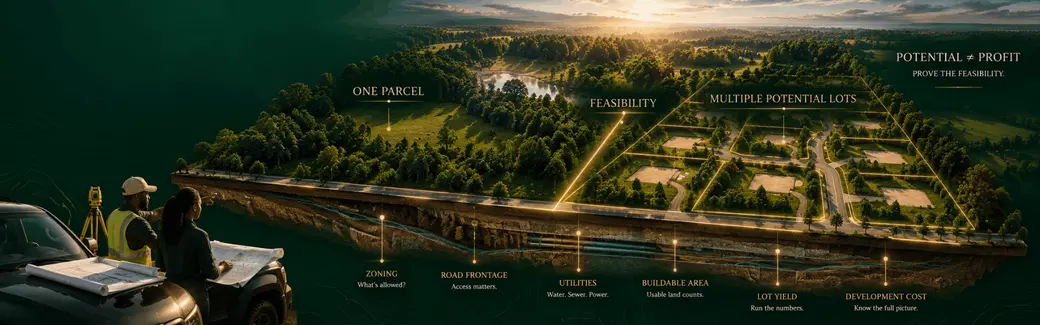
Unlocking Hidden Value: Can You Subdivide Your Property in Hampton, GA?
When most property owners look at five, ten, or twenty acres, they see one property.
A land investor may see something very different.
They may see:
Multiple potential homesites.
Several individual lots.
A small residential development.
A parcel that could potentially be worth more divided than it is whole.
That's the strategy behind land subdivision.
If you own acreage in Hampton or southern Henry County, your property may have development potential you haven't considered. But before assuming you're sitting on a gold mine, there's an important distinction:
Having acreage doesn't automatically mean you can subdivide it profitably.
The real opportunity is discovered through due diligence.
First: What Does It Mean to Subdivide Land?
At its simplest, subdividing means taking one larger legal parcel and creating two or more separate parcels.
Imagine owning 12 acres.
Instead of selling one 12-acre tract, there might be a scenario where the property can legally and practically be divided into several residential lots.
Those individual lots could potentially be:
- Sold to builders
- Sold directly to consumers
- Held for future development
- Developed individually
- Packaged as part of a larger investment strategy
But the number of lots you can create isn't determined simply by dividing the total acreage by your desired lot size.
Usable acreage and total acreage are not necessarily the same thing.
That's where the analysis begins.
The First Question: Is Your Property Actually in Hampton?
This may sound obvious, but it's extremely important.
A property can have a Hampton mailing address without necessarily being located inside the incorporated City of Hampton.
That matters because the applicable zoning and development authority can differ.
Henry County's parcel data includes fields for jurisdiction, zoning, acreage, floodplain and future land-use information, and the county maintains current zoning and future-land-use mapping resources.
So before discussing development potential, determine:
City of Hampton or unincorporated Henry County?
That's Step One.
The Subdivision Feasibility Test
Before getting excited about the potential number of lots, I would evaluate a Hampton-area parcel through several filters.
1. Start With Current Zoning
Zoning tells you what the property is currently entitled to do.
Henry County's current zoning map contains multiple residential and agricultural/residential classifications, meaning you cannot assume that every Hampton-area acreage parcel has the same development rights.
Inside Hampton, the city also maintains its own zoning regulations, which have undergone recent amendments.
For a particular property, verify the current zoning designation and then determine the requirements associated with it.
Those requirements may affect issues such as:
Permitted residential uses
Minimum lot dimensions
Setbacks
Density
Road frontage
Access
Development standards
And potentially much more.
Don't start with:
| “I have 10 acres. How many lots can I get?”
Start with:
| “What does the current zoning allow me to do with these 10 acres?”
That's a much more useful question.
2. Don't Confuse Acreage With Buildable Acreage
Suppose someone owns 10 acres.
They assume:
| “If one-acre lots are allowed, I'll get 10 lots.”
Not necessarily.
A subdivision concept may have to account for land needed for access and infrastructure, as well as physical or regulatory constraints.
The property may contain:
Floodplain
Streams or drainage features
Steep or difficult terrain
Utility easements
Access limitations
Irregular parcel boundaries
Areas unsuitable for septic systems
Road or infrastructure requirements
That's why a raw acreage calculation can significantly overstate development potential.
The investor isn't buying acres.
The investor is buying usable development potential.
3. Road Frontage Can Change Everything
One of the first things I look at when evaluating land is how the parcel meets the road.
Why?
Because access can dramatically affect subdivision design.
Imagine two 10-acre parcels.
Parcel A
Long road frontage, relatively rectangular configuration, good access and manageable topography.
Parcel B
Narrow frontage with most acreage sitting far behind another property.
Same acreage.
Completely different development problem.
Depending on the project and governing regulations, creating multiple lots may require new access, driveway approvals, internal roads or other improvements.
That means a parcel's shape and frontage can sometimes matter nearly as much as its acreage.
4. Water and Sewer—or Septic?
Here's where a beautiful piece of land can become much more complicated.
How will future homes receive water?
Where will wastewater go?
If public utilities are available and capacity and connections are feasible, the development scenario may look one way.
If the lots require individual septic systems and wells or other solutions, the analysis changes.
For septic-dependent development, soils and site suitability can become critical.
A parcel that appears large enough on a map may not necessarily support the number of homesites an owner imagined.
This is why a land investor needs to investigate utilities before assigning a value to hypothetical lots.
5. The Survey Can Reveal What the Listing Cannot
Aerial photography is helpful.
Tax records are helpful.
Online maps are helpful.
But none of them replace professional due diligence.
For serious subdivision analysis, a surveyor and potentially a civil engineer can help evaluate issues such as:
Actual boundaries
Easements
Existing improvements
Road frontage
Potential lot configuration
Access
Topography
Infrastructure requirements
A conceptual subdivision plan can transform the conversation from:
| “I think we could get six lots.”
to:
| “Here's what a professional believes may actually be feasible, subject to governmental approval.”
That difference matters enormously when you're negotiating with investors or builders.
The Hidden-Value Strategy: One Parcel vs. Multiple Lots
This is where subdivision becomes interesting from an investment perspective.
Suppose you own a large tract.
You could potentially sell it as:
One Large Parcel
Simpler transaction.
One buyer.
Minimal development involvement.
Potentially faster exit.
Or you might explore:
Multiple Finished or Approved Lots
More complex.
More upfront cost.
More approvals.
More time.
But potentially a different overall value proposition.
There's also a middle strategy.
Entitle or Prepare the Property, Then Sell
Instead of physically developing every lot yourself, you might investigate the property, obtain surveys, explore approvals, and market the property to a builder or developer with more certainty around its potential.
That can potentially reduce some of the uncertainty a developer would otherwise have to price into an offer.
But approvals aren't guaranteed, and the cost of obtaining them needs to be compared with the potential increase in marketability or value.
Think Like a Developer: Work Backwards
This is one of my favorite ways to evaluate land.
Don't start by asking:
“What could I sell each lot for?”
Start with:
“What would it cost to create each marketable lot?”
Those are very different questions.
Your feasibility analysis might need to consider:
Land acquisition or existing land basis
Surveying
Engineering
Soil testing
Legal expenses
Application and review fees
Clearing
Grading
Road construction
Drainage
Stormwater infrastructure
Utilities
Water/sewer connections where applicable
Septic or well costs where applicable
Landscaping or buffers
Holding costs
Financing costs
Taxes
Insurance
Sales and marketing
Contingency reserves
Then compare those expenses with realistic market values for the resulting lots.
Gross lot value is not profit.
That's the distinction that separates speculation from investment analysis.
The $500,000 Illusion
Here's a hypothetical example.
Imagine someone believes a subdivision could create five lots worth $100,000 each.
They immediately think:
“My property is worth $500,000!”
Not so fast.
If achieving those five lots requires significant engineering, infrastructure, roads, utility work, professional fees, carrying costs and approvals, the actual economics could look dramatically different.
And there's another possibility:
What if only four lots are feasible?
Or three?
This is why I recommend evaluating several scenarios.
Conservative Scenario
Fewer lots + higher development costs.
Expected Scenario
Most probable lot yield + realistic costs.
Optimistic Scenario
Higher feasible yield + favorable development costs.
If the deal only works under the optimistic scenario, that's a warning sign.
Don't Forget the Exit Buyer
Who will ultimately purchase what you're creating?
That's one of the most important questions in land investing.
Your exit might be:
Individual homeowners looking for custom-home lots
Small local builders
Larger residential builders
Another land investor
A developer
Each buyer looks at land differently.
A homeowner may pay attention to privacy, acreage and lifestyle.
A builder may ask:
“What's my finished-lot cost?”
A developer may ask:
“How many units can I actually get approved?”
An investor may ask:
“What's my margin after carrying and development costs?”
Your subdivision strategy should begin with the likely end buyer—not merely the amount of acreage you own.
Could Rezoning Unlock More Value?
Possibly.
But this is where landowners need to be careful.
The property's current zoning may not support the owner's desired development plan.
A landowner might investigate whether rezoning, a different development approach, or another approval process is available.
But rezoning should never be treated as guaranteed.
The City of Hampton has recently updated portions of its zoning framework, and its planning materials show that development standards and permitted density can differ substantially by district. For example, city planning documents describe certain MR-1 and MR-2 areas at eight units per acre, while recent amendments describe different standards for particular mixed-use and downtown districts. Those examples should not be applied to a specific parcel without verifying its zoning and location.
That's exactly why parcel-level analysis matters.
A Simple Hampton Landowner Checklist
Before marketing acreage as “development potential,” answer these questions:
- What jurisdiction is the property actually in?
- What is the current zoning?
- What does that zoning currently permit?
- What is the future land-use designation?
- How much road frontage exists?
- Are public water and sewer available and feasible?
- If septic is needed, has soil suitability been evaluated?
- Are there floodplain, drainage, stream, easement or topographic constraints?
- What subdivision and infrastructure standards would apply?
- What would surveying and engineering cost?
- How many lots appear realistically feasible?
- What are comparable buildable lots actually selling for?
- Who is the most likely buyer for the finished product?
- What is the estimated net return after development and carrying costs?
If you can't answer those questions yet, you don't know the property's subdivision value.
You know its acreage—not its potential.
Should You Subdivide—or Sell the Acreage As-Is?
Not every landowner should become a developer.
Sometimes the best strategy may be selling the entire tract.
Sometimes it may be creating only two parcels.
Sometimes it may be completing preliminary feasibility work and selling to a builder.
And sometimes a more extensive subdivision strategy could make sense.
The right decision depends on your:
Timeline
Risk tolerance
Available capital
Property characteristics
Zoning
Development costs
Target buyer
Expected net proceeds
This is why I would never tell a Hampton landowner:
| “You should subdivide.”
before completing the analysis.
Instead, I would ask:
“Which strategy creates the strongest risk-adjusted outcome for this particular property?”
The Takeaway: Your Acreage May Be Worth More Than You Think—but Prove It First
Land has something existing houses don't:
Optionality.
One parcel may potentially become multiple lots.
A homesite may potentially become an investment opportunity.
Unused acreage may potentially have a completely different highest-and-best-use story.
But potential alone doesn't create value.
Feasibility creates value.
Before subdividing land in Hampton or Henry County, investigate the property's jurisdiction, zoning, future land use, access, utilities, physical constraints, subdivision requirements, professional costs and likely end buyer.
Only then can you begin answering the question:
“Is this land more valuable together—or divided?”
That is where the real land-investment strategy begins.
Do you own acreage in Hampton, Georgia or elsewhere in Henry County and wonder whether you're maximizing its potential?
Before simply putting a “For Sale” sign on the property, let's evaluate the bigger picture.
Connect with Natasha Ewing Johnson to begin a strategic land analysis. We can examine the property's location, current zoning information, surrounding development, comparable land sales and potential buyer profile—and identify which additional professionals or governmental departments should be consulted before you make your next move.
Don't just sell the acreage. Understand what you're actually selling.
This article is educational and is not legal, engineering, surveying, zoning, tax, investment, or land-development advice. Development potential and subdivision approval are property-specific. Verify current requirements with the applicable City of Hampton or Henry County department and qualified professionals before purchasing, marketing, subdividing or developing property.
Frequently Asked Questions
Can I subdivide my land in Hampton, GA?
Possibly, but acreage alone doesn't determine whether subdivision is allowed. You first need to establish whether the parcel is inside Hampton city limits or unincorporated Henry County, then verify zoning, access, utilities, physical constraints and applicable subdivision requirements.
How do I find the zoning for land in Henry County?
Henry County maintains parcel and zoning mapping resources that include zoning and other land-related fields. Use them as a starting point, then confirm the information with the appropriate planning authority before making an investment decision.
Does a Hampton mailing address mean the property is inside the City of Hampton?
Not necessarily. Verify the property's governmental jurisdiction rather than relying solely on the postal address.
Does subdividing land automatically increase its value?
No. Smaller lots may have a higher combined gross value in some circumstances, but surveying, engineering, infrastructure, utilities, approvals, financing and holding costs can materially affect the net result.
Should I subdivide before selling to a builder?
It depends. Some builders may prefer entitled or development-ready lots, while others are equipped to handle the development process themselves. Compare the potential increase in proceeds with your cost, time and risk.
Do I need a surveyor to subdivide property?
Professional surveying is generally a critical part of creating legal parcels. Depending on the project, you may also need a civil engineer, land-use attorney, soil professional and other specialists.
Categories
Recent Posts