
Relocating With Pets to Henry County, GA: A Cross-Country Moving Guide for Dogs, Cats, Horses & Livestock
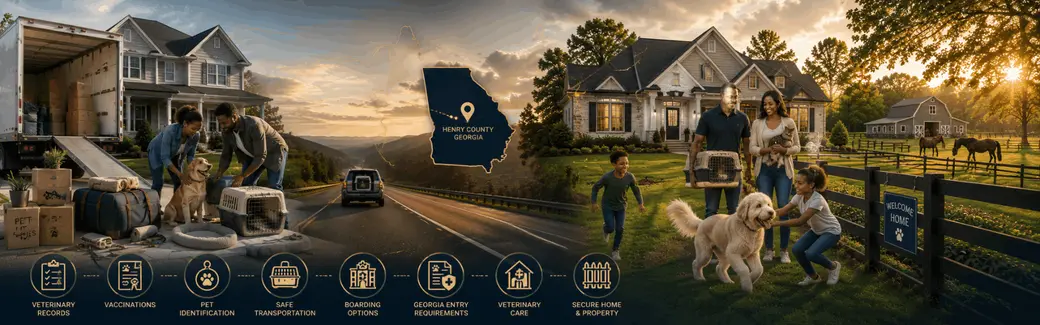
The Cross-Country Pet Move: Relocating With Animals to Henry County, Georgia
Moving from New York, California, Texas, or another state to Henry County involves more than finding the right house, scheduling movers, and transferring utilities.
If your family includes dogs, cats, horses, chickens, goats, or other animals, you're actually coordinating two moves at the same time.
Your furniture needs a destination.
So do your animals.
And unlike the sofa, they may need vaccination records, veterinary appointments, transportation arrangements, boarding reservations, fencing, climate considerations, or state animal-entry documentation before they ever reach your new driveway.
That's why animal relocation should be part of your home-search strategy from the beginning—not something you figure out the week before closing.
Your Pet Changes What “The Right House” Means
Tell me you're relocating with three children, and I'll ask about bedrooms and daily routines.
Tell me you're relocating with two Great Danes, and suddenly I'm thinking about:
Fencing. Yard configuration. HOA restrictions. Nearby veterinary care. Boarding options.
Tell me you're bringing horses?
Now we're having a completely different real estate conversation.
We're evaluating acreage, zoning, pasture, fencing, trailer access, outbuildings, water availability, and proximity to large-animal veterinary services.
The lesson is simple:
Don't find the house first and figure out whether your animals fit later.
Make your animals part of the property criteria from Day One.
Step 1: Know Georgia's Animal Entry Requirements
This is the part you don't want to discover at the state line.
The Georgia Department of Agriculture's Bringing Animals Into Georgia guide should be one of your first stops when planning an interstate animal move.
Georgia currently requires dogs and cats entering the state to have proof of a current approved rabies vaccination. The state's requirements become more detailed for livestock and certain other species.
For livestock, Georgia generally requires an official Certificate of Veterinary Inspection or applicable permit documentation, with requirements varying by species.
That's an important distinction.
Moving your family dog isn't necessarily the same regulatory process as moving:
Horses. Cattle. Goats. Sheep. Swine. Poultry.
Check the rules for the specific species you're transporting.
Important 2026 Travel Update
Animal-movement requirements can change quickly because of disease-control measures.
For example, in June 2026 the Georgia Department of Agriculture announced enhanced interstate requirements affecting warm-blooded animals arriving from certain areas following New World Screwworm detections. Those requirements have already evolved as the situation changed.
So don't save an animal-entry checklist six months before moving and assume it's still current.
Recheck Georgia's requirements shortly before departure.
Step 2: Build Your Animal Moving File
Create one digital folder for each animal—or herd/flock where appropriate.
For domestic pets, consider keeping copies of:
- Rabies certificate
- Vaccination history
- Veterinary records
- Prescription information
- Microchip information
- Recent photograph
- Current veterinarian contact information
- Insurance information, if applicable
- Emergency contacts
For livestock and horses, your documentation requirements may be considerably different.
Georgia says livestock entering the state are subject to species-specific entry requirements, so coordinate with your veterinarian and review current state rules well before transportation.
Step 3: Establish Your Henry County Veterinarian Before Moving Day
Don't wait until your dog gets sick three days after arriving to start searching for a veterinarian.
Before your move, identify several practices convenient to your new home and contact them directly about:
New-patient availability.
Services offered.
Record transfers.
Prescription continuity.
Emergency procedures.
Current local options include Henry County Veterinary Hospital in McDonough, Stockbridge Veterinary Hospital in Stockbridge, The Grove Animal Hospital in Locust Grove, and The Healthy Pet Veterinary Clinic in McDonough.
These are starting points, not endorsements. Confirm current services, appointment availability, species treated, emergency capabilities, and pricing directly with each provider.
Step 4: Create a Boarding Backup Plan
Here's the relocation problem nobody expects.
Your closing gets delayed.
The moving truck arrives tomorrow.
Your temporary hotel doesn't accept your dog.
Now what?
That's why I recommend identifying a Plan B boarding facility before leaving your previous state.
Current Henry County-area options include That's Ruff Pet Hotel, The Paw Pad, Paws Country Club, and Luxe Boarding and Pet Care.
Before reserving, ask about vaccination requirements, temperament evaluations, medications, feeding routines, check-in hours, cancellation policies, and availability around your moving dates.
That last point matters.
Your pet's reservation should have some flexibility around closing day.
Step 5: Horses and Livestock Need a Different Relocation Plan
This isn't simply a bigger version of moving a dog.
If you're relocating horses or livestock to South Metro Atlanta, the property itself needs considerably more due diligence.
Before purchasing acreage, investigate:
Current zoning and permitted animal uses.
HOA or deed restrictions.
Fencing.
Pasture condition.
Water.
Shelter.
Trailer access.
Road access.
Drainage.
Feed and hay storage.
Veterinary access.
Emergency transportation.
And don't assume that a property marketed as having "5 beautiful acres" automatically works for your animals.
Acreage and usable animal acreage are not the same thing.
Wooded areas, steep terrain, drainage areas, easements, septic fields, setbacks, and other physical or regulatory constraints can change how much of the land actually supports your intended use.
Find Large-Animal Veterinary Care Early
Your normal small-animal clinic may not provide equine or livestock services.
Current regional search results include King Equine Vet Services and, farther outside Henry County, Fulton Equine Clinic in Griffin and Thompson Veterinary Services (Mobile and Office For Large and Small Animals) in Barnesville.
Before relying on any provider, confirm the species treated, service radius, emergency coverage, farm-call policies, and whether they're accepting new clients.
For interstate livestock requirements, start with the Georgia State Veterinarian's Office rather than relying on social-media advice.
Step 6: Think About the Drive From Your Animal's Perspective
A cross-country move may mean days on the road.
Build the itinerary around the animal—not simply the fastest GPS route.
For dogs and cats, that may mean planning appropriate rest stops, pet-friendly overnight accommodations, food and medication schedules, secure carriers or restraints, and veterinary contingency stops.
Never assume every hotel that describes itself as "pet friendly" accepts:
Your number of animals.
Your animal's size.
Your breed.
Or multiple pets in the same room.
Call ahead.
Flying? Check Two Sets of Rules
If your pet is flying into Georgia, you need to consider both:
Georgia requirements
and
Airline requirements.
The Georgia Department of Agriculture specifically advises travelers arriving by plane to contact their airline because carriers may impose additional requirements beyond the state's entry rules.
That's another reason to plan early.
Step 7: Make the New House Animal-Ready Before Arrival
You don't want your dog discovering the broken section of backyard fence before you do.
If possible, conduct an animal-focused property check before move-in.
For dogs, inspect:
Fence gaps. Gates. Deck openings. Yard hazards.
For cats:
Window screens. Exterior doors. Garage access.
For horses and livestock:
Fencing. Gates. Pasture. Shelter. Water systems. Trailer access.
If the home sits near a busy road, pay particular attention to containment.
Your first night shouldn't become a neighborhood search party.
Don't Introduce Everything at Once
Moving day is chaotic.
Doors stay open.
Strangers carry furniture.
Boxes are everywhere.
Moving trucks make noise.
Your pet doesn't understand that you've just bought a beautiful new home.
They understand:
"Everything I know just changed."
Consider establishing one quiet, secure space before introducing the animal to the entire property.
Bring familiar bedding, toys, bowls, food, and routines where practical.
The objective is to make the new environment feel predictable as quickly as possible.
Your Home Search Radius May Change Because of Your Animals
This is where animal relocation becomes real estate strategy.
Suppose two homes are nearly identical.
Home A is five minutes closer to your office.
Home B offers:
A securely fenced yard.
Better access to your veterinarian.
More appropriate space for your animals.
No conflicting HOA restriction you've identified.
Home B may produce the better daily lifestyle even though your commute is slightly longer.
Relocation isn't just about the person going to work.
It's about how the entire household functions after the boxes disappear.
The Livestock Property Test
If you're relocating with horses, goats, chickens, or other livestock, don't ask only:
"Can I keep animals here?"
Ask:
What species are permitted?
How many?
Are there minimum acreage requirements?
What structures are allowed?
What setbacks apply?
Are there private deed restrictions?
Can I build the barn I need?
Can a horse trailer enter and turn around?
Can my veterinarian access the animals?
Those answers should be verified with the applicable jurisdiction and appropriate professionals for the specific property.
Never rely solely on a listing description.
Your 30-Day Cross-Country Pet Move Timeline
30+ Days Before Moving
Confirm current Georgia entry requirements, contact your veterinarian, begin transferring records, research transportation, and identify your new veterinary and boarding options.
14–30 Days Before
Confirm reservations, medications, identification, vaccination records, and species-specific documentation.
7 Days Before
Recheck state requirements, transportation arrangements, weather, overnight accommodations, and your backup boarding plan.
24–48 Hours Before
Pack the animal's essentials separately from household belongings.
Arrival Day
Secure the property first. Then introduce animals gradually.
First Week
Establish feeding, exercise, medication, and veterinary routines while monitoring how your animal adjusts.
Build an Animal Emergency Bag
Keep this with you, not inside the moving truck.
Consider packing:
- Food
- Water
- Bowls
- Medication
- Leash/harness
- Carrier
- Waste supplies
- Towels
- Bedding
- Veterinary documentation
- Identification information
- Recent photographs
- Basic first-aid supplies recommended by your veterinarian
If your movers arrive three days late, your animals shouldn't lose access to their essentials.
Final Thoughts
A successful cross-country relocation isn't complete when the furniture arrives.
It's complete when every member of the household can safely settle into the new community—including the ones with paws, hooves, or feathers.
If you're moving to McDonough, Stockbridge, Hampton, Locust Grove, or elsewhere in Henry County, make animal logistics part of your relocation strategy from the beginning.
Check Georgia's entry rules.
Transfer veterinary records.
Secure boarding backups.
Research large-animal care when necessary.
Verify property restrictions before purchasing.
And choose a home that works for the lifestyle you're actually bringing with you.
Because the right relocation property shouldn't simply accommodate your family.
It should accommodate your entire family.
Call to Action
Planning an out-of-state move to Henry County, Georgia with pets, horses, or livestock?
Let's build your home search around more than bedrooms, bathrooms, and commute times. Your Pet-Friendly Relocation Plan can incorporate property type, yard or acreage needs, local veterinary access, boarding options, and the practical logistics your animals require.
For animal health and interstate movement requirements, we'll point you toward the appropriate state agencies and veterinary professionals so you can verify the rules before traveling.
FAQs
What does my dog or cat need to enter Georgia?
Georgia currently requires dogs and cats entering the state to have proof of a current approved rabies vaccination. Specific circumstances can create additional requirements, so check current rules before traveling.
Do livestock need health certificates when moving to Georgia?
Georgia states that livestock entering the state are subject to species-specific requirements and generally require applicable veterinary inspection or permit documentation. Verify the exact requirements for your species before transportation.
Should I find a veterinarian before relocating?
Yes. Establishing potential veterinary care before arrival gives you somewhere to call if your animal becomes sick or needs medication soon after moving.
Should I reserve boarding even if I don't plan to use it?
For a long-distance relocation, having a backup option can be valuable because closing dates, movers, travel, and temporary accommodations can change unexpectedly.
Can I keep horses or livestock on any large property in Henry County?
Don't assume so. Verify zoning, applicable ordinances, private restrictions, HOA rules where relevant, and the suitability of the individual property before purchasing.
Are Georgia animal-entry rules permanent?
Requirements can change, particularly in response to animal-health events. Georgia implemented additional interstate measures in 2026 following New World Screwworm detections outside Georgia, illustrating why relocators should check current guidance shortly before travel.
Categories
Recent Posts