Commercial Multi-Tenant Conversions: The Next Wave for Southside Metro Atlanta Investors
Commercial Multi-Tenant Conversions: The Next Wave for Southside Investors
The next commercial real estate opportunity may not be a brand-new building.
It could be an older property everyone else has overlooked.
Across South Metro Atlanta, investors evaluating dated office buildings, former professional spaces, and underutilized commercial properties should be asking a different question:
What if one tenant isn't the highest and best use of this building?
Instead of relying on a single business to lease an entire property, a strategically designed building may support multiple smaller tenants—such as accountants, attorneys, consultants, therapists, insurance professionals, beauty or wellness businesses where permitted, remote teams, and other service-based operators.
The concept is straightforward:
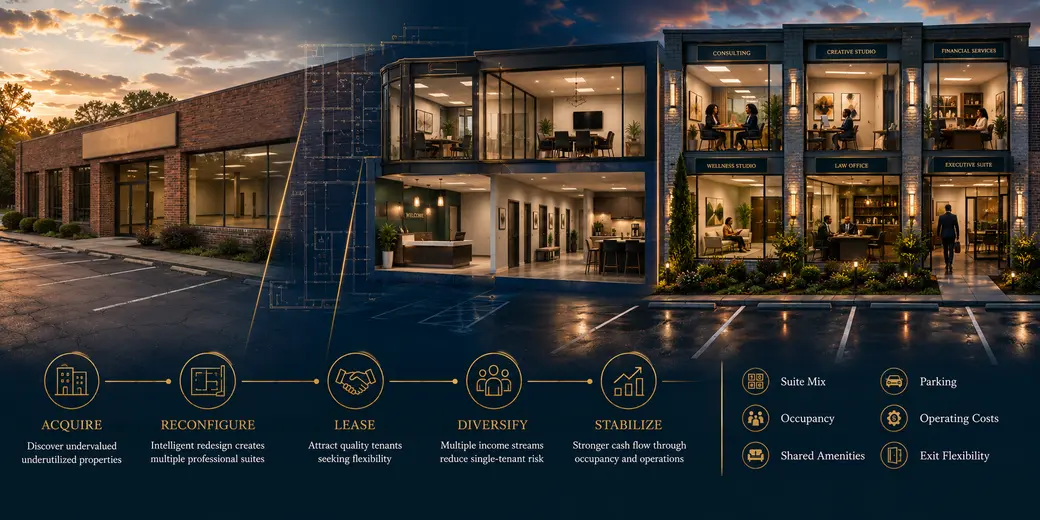
Acquire → Reconfigure → Improve → Lease Smaller Spaces → Diversify Income
But profitable execution is far more complicated.
Before assuming an outdated commercial property can become a high-performing executive-suite investment, investors need to understand tenant demand, zoning, parking, construction costs, operating expenses, lease structure, and exit strategy.
Why Multi-Tenant Commercial Space Is Worth Watching
Traditional commercial properties often depend heavily on one tenant.
If that tenant leaves, occupancy can go from:
100% → 0%
almost overnight.
A multi-tenant property changes that equation.
Imagine a building configured for eight independent occupants.
One vacancy doesn't necessarily eliminate the entire property's rental income.
That creates the possibility of income diversification within a single asset.
However, diversification doesn't automatically mean lower risk. Smaller tenants can have higher turnover, shorter lease commitments, greater management requirements, and more frequent leasing expenses.
The investment thesis has to work after accounting for those realities.
1. Start With the Building Nobody Else Knows How to Use
Some of the most interesting conversion candidates aren't necessarily attractive at first glance.
Think:
Older professional office buildings
Former medical or administrative spaces
Oversized single-user offices
Underutilized neighborhood commercial properties
Buildings with outdated interiors but workable structural layouts
An investor may see worn carpet, old fluorescent lighting, and dated conference rooms.
A strategist sees:
Private offices.
Shared reception.
Conference facilities.
Break room.
Storage.
Multiple potential revenue-producing spaces.
The opportunity isn't simply renovating an ugly building.
It's changing how the building produces income.
2. Smaller Spaces Can Serve a Different Tenant Market
Not every business needs 3,000 square feet.
A solo professional may need:
One private office.
A small firm may need:
Two offices plus conference-room access.
A growing company may need:
A small suite without the commitment of a large traditional lease.
That creates an opportunity for investors to offer different configurations within the same property.
For example:
Private Executive Offices
Individual lockable offices with shared common areas.
Small Professional Suites
Two or three connected offices for small teams.
Shared Conference Space
Reservable meeting rooms that reduce the need for every tenant to lease additional square footage.
Flexible Multi-Use Space
Rooms that can support appropriate professional or service uses when permitted.
The more efficiently common areas are designed, the more effectively an investor may be able to monetize the building's usable space.
3. The Real Opportunity Is Revenue Density
Here's where investors should pay attention.
Suppose a traditional property could be leased to one tenant.
Now imagine that same building divided into several appropriately designed smaller suites.
The question becomes:
Can the total rent generated by the smaller spaces exceed what the property could reasonably generate as a single-tenant building—after accounting for additional costs?
That's the real analysis.
Not:
“How much can I charge per office?”
But:
“What is my sustainable net operating income after stabilization?”
That distinction matters.
4. Gross Rent Is Not Profit
This is where an exciting executive-suite concept can quickly become a bad investment.
Multi-tenant operations may create additional expenses.
Depending on the lease structure, ownership could be responsible for some combination of:
- Electricity
- Water
- Internet
- Common-area cleaning
- Landscaping
- Security
- Property management
- Common-area maintenance
- Repairs
- Insurance
- Property taxes
- Furnishings
- Access-control systems
- Leasing and marketing
- Turnover expenses
A property producing impressive gross revenue can still generate disappointing cash flow.
Investors should model:
Potential Gross Income
minus
Vacancy and Credit Loss
minus
Operating Expenses
equals
Net Operating Income
Then compare that result against the total investment.
5. Don't Underestimate Conversion Costs
Turning an old office building into attractive multi-tenant space isn't just:
Paint + furniture + Wi-Fi.
Depending on the building and proposed use, the project could involve:
Interior walls
Electrical work
HVAC modifications
Plumbing
Restrooms
Accessibility improvements
Fire/life-safety requirements
Lighting
Doors and access control
Sound separation
Signage
Parking considerations
Permits
Technology infrastructure
A building that looks inexpensive at acquisition can become expensive once professional plans and construction requirements enter the picture.
That's why conversion feasibility should be investigated before closing, not after.
6. HVAC Can Make or Break the Floor Plan
This is one of the less glamorous details investors can overlook.
Imagine creating 12 beautiful private offices.
But the HVAC system was designed for one open office floor.
Now some rooms are freezing while others are uncomfortable.
Or tenants can't control their environment after hours without conditioning the entire building.
That affects:
Tenant satisfaction.
Utility costs.
Retention.
Build-out costs.
Before finalizing a multi-suite plan, have qualified professionals evaluate whether the building's mechanical systems can realistically support the proposed configuration.
7. Parking Is Part of Your Revenue Model
You can create more offices.
You can't always create more parking.
Suppose you convert a low-density commercial building into numerous individual suites.
Each suite potentially adds:
A tenant.
Employees.
Clients.
Visitors.
Suddenly, the building may generate much more traffic than it did under its previous configuration.
Parking requirements can also be affected by the property's legal use and applicable local regulations.
So before underwriting:
“15 rentable suites × projected monthly rent”
ask:
Can the property legally and practically support 15 occupied suites?
That is a much better question.
8. Zoning Comes Before Interior Design
Don't fall in love with your floor plan before verifying whether the proposed uses are allowed.
A building's existing commercial use doesn't automatically mean every business you want to lease to is permitted.
Professional office use can be treated differently from uses such as:
Medical
Personal services
Salon suites
Certain wellness services
Educational uses
Food-related businesses
Assembly or event uses
And requirements can vary by jurisdiction and property.
Before acquisition, verify the property's zoning and intended tenant mix with the applicable local authority and appropriate professionals.
9. Build Around a Tenant Ecosystem
One of the more interesting strategies isn't simply filling rooms.
It's creating a complementary business ecosystem.
Imagine a professional building containing:
CPA
Attorney
Insurance professional
Real estate-related service
Consultant
Marketing professional
Business coach
Financial professional
Now the building potentially becomes more than a collection of doors.
Tenants may benefit from proximity to complementary businesses and shared clientele.
That can help differentiate the property from generic office inventory.
The same concept could potentially work for other compatible professional categories, subject to zoning and other applicable requirements.
10. Design Shared Space Intentionally
Every square foot of common area has a cost.
But eliminating too much common space can reduce the experience tenants are paying for.
A well-designed multi-tenant property might include:
Professional reception area
Conference room
Break room
Print/mail area
Restrooms
Waiting area
Secure access
The objective is balance.
Too much common space can reduce rentable area.
Too little can make the property feel like a hallway full of doors.
11. Underwrite Three Occupancy Scenarios
Never build your acquisition model around perfect occupancy.
Run at least three scenarios.
Conservative
What happens if leasing takes longer than expected and several suites remain vacant?
Target
What happens at a realistic stabilized occupancy assumption supported by market research?
Stress Test
What happens if rents underperform while utilities, insurance, taxes, or maintenance exceed expectations?
If the deal only works under your most optimistic assumptions, that's information you need before purchasing.
12. Know Your Break-Even Occupancy
This is one of the most useful numbers in a multi-tenant deal.
Ask:
How many suites must remain occupied for this property to cover its operating obligations and applicable debt service?
If you need virtually every office occupied every month just to stay afloat, your margin for error may be thin.
If the building can withstand several vacancies and still remain financially manageable, that's a different risk profile.
The exact calculation should be based on the property's real expenses, financing, lease structure, and capital requirements.
13. Tenant Turnover Changes the Management Model
A single-tenant commercial building might involve one lease relationship.
A multi-suite property could involve:
10, 15, or 20 separate relationships.
That means:
More leases.
More payments.
More renewals.
More access issues.
More maintenance requests.
More move-ins.
More move-outs.
More marketing.
Potentially more management.
The strategy can create diversified income, but it can also become a more operationally intensive business.
Investors need to decide whether they want to own commercial real estate or operate a flexible-space business—or both.
14. The “Inflation-Proof” Idea Needs a Reality Check
Real estate is often discussed as an inflation hedge because rents and property values may adjust over time.
But no commercial investment is literally inflation-proof.
Operating costs can rise.
Insurance can rise.
Property taxes can change.
Utilities can become more expensive.
Construction costs can increase.
Tenant demand can weaken.
Financing conditions can shift.
A better objective is to build an asset with multiple income streams, adaptable space, disciplined expenses, and enough pricing flexibility to respond to changing conditions.
That's more defensible than assuming inflation can't hurt the investment.
15. Your Exit Strategy Starts Before Acquisition
Before converting the building, ask:
Who buys this asset from me later?
Could another investor operate it as multi-tenant space?
Could it be returned to a more traditional office configuration?
Could a future owner occupy part and lease the remainder?
Does the conversion improve flexibility—or make the property so specialized that the future buyer pool shrinks?
This matters because the best conversion projects create optionality.
You don't want your only exit strategy to depend on finding another investor who loves your exact operating model.
The Southside Investor Conversion Scorecard
Before pursuing a commercial multi-tenant conversion in South Metro Atlanta, evaluate the property across these categories:
Location: Is the property convenient to the businesses and customers likely to use it?
Visibility: Can potential tenants and their clients easily find it?
Parking: Can the site accommodate the proposed occupancy and uses?
Layout: Can the floor plan be divided efficiently?
Mechanical Systems: Can HVAC, electrical, plumbing, and technology support multiple tenants?
Zoning: Are the intended uses permissible?
Build-Out: What will conversion realistically cost?
Tenant Demand: Is there evidence that businesses want smaller suites in this submarket?
Operating Expenses: What does ownership pay after conversion?
Break-Even Occupancy: How much vacancy can the property withstand?
Exit Flexibility: Can the building serve another purpose later?
If several of those answers are unclear, the investment isn't ready for acquisition yet.
Final Thoughts: Buy the Building, Underwrite the Business
Commercial multi-tenant conversions can be an intriguing strategy for investors looking beyond traditional residential acquisitions.
The appeal is understandable.
One building.
Multiple tenants.
Multiple revenue streams.
Potentially more efficient use of underutilized commercial space.
But successful execution requires more than dividing a building into offices and putting locks on the doors.
You need to understand:
Demand.
Zoning.
Construction.
Parking.
Operating expenses.
Tenant management.
Exit value.
The smartest South Metro Atlanta investors won't simply ask:
“How cheap can I buy this outdated building?”
They'll ask:
“What can this property legally, physically, and economically become?”
That's where the real opportunity begins.
Looking for underutilized commercial properties with multi-tenant conversion potential across South Metro Atlanta?
Connect with Natasha Ewing Johnson to explore commercial opportunities that may support executive suites, professional offices, owner-user configurations, or other flexible commercial strategies.
We'll begin by evaluating the property, location, layout, potential tenant demand, and exit strategy—then bring in the appropriate commercial lenders, contractors, architects, zoning professionals, attorneys, accountants, and other specialists needed to verify the business case.
Don't just buy commercial square footage. Build an investment strategy around what that square footage can become.
Frequently Asked Questions
What is a commercial multi-tenant conversion?
It's the repositioning of a commercial property so multiple businesses can occupy separate suites or spaces rather than relying on one primary tenant.
Are executive suites more profitable than traditional office leases?
They can potentially generate different revenue economics, but profitability is not guaranteed. Investors need to account for vacancy, turnover, utilities, management, build-out costs, common areas, and other operating expenses.
What properties make good executive-suite conversion candidates?
Properties with efficient layouts, adequate parking, appropriate zoning, suitable mechanical systems, good accessibility, and demonstrated local tenant demand may warrant further evaluation.
Can any commercial building be converted into multiple office suites?
No. Zoning, occupancy classifications, building codes, fire/life-safety requirements, accessibility, parking, utilities, permits, and physical limitations can affect feasibility.
Is multi-tenant commercial real estate inflation-proof?
No investment is literally inflation-proof. Multi-tenant properties may offer income diversification and potential pricing flexibility, but expenses, vacancies, financing costs, and market conditions can still affect returns.
Should I buy the property before designing the conversion?
Ideally, investors should perform meaningful feasibility and due diligence before acquisition. Appropriate professionals can help determine whether the intended conversion is physically, legally, and economically realistic.
Categories
Recent Posts