
How to Leverage Seller Concessions to Lower Your Mortgage Interest Rate Right Now
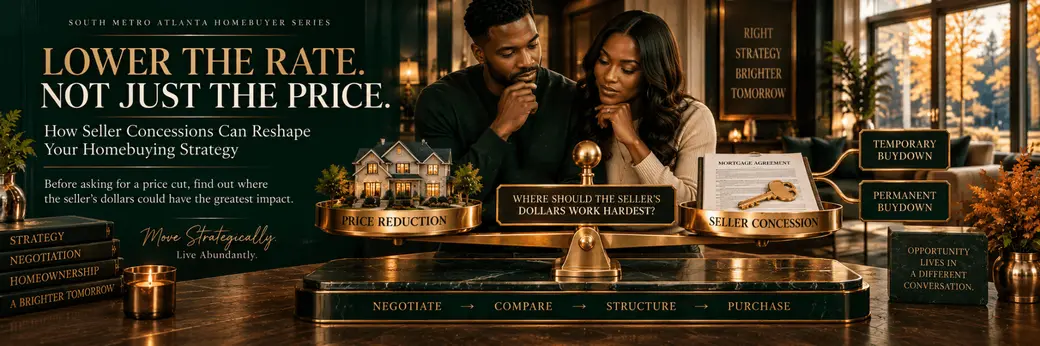
How to Leverage Seller Concessions to Lower Your Interest Rate Right Now
Higher mortgage rates don't necessarily have to put your homebuying plans on hold.
Many buyers look at the interest rate they are quoted and immediately assume they have only two choices:
Buy at today's available rate—or wait and hope rates eventually come down.
But there may be a third conversation worth having.
Can we negotiate the transaction in a way that helps improve the financing?
Depending on the property, seller, loan program, lender and terms of the transaction, a seller concession may potentially be used toward eligible closing expenses or an interest-rate buydown.
Instead of focusing exclusively on getting the seller to slash the purchase price, a strategic buyer can ask:
Where will the seller's dollars have the greatest impact on my transaction?
That can completely change how you negotiate a home purchase.
First, What Is a Seller Concession?
A seller concession is an agreed contribution from the seller toward certain buyer expenses associated with the transaction.
Depending on the loan program and transaction, allowable concessions may potentially help with eligible closing costs, prepaid expenses, discount points, or certain interest-rate buydown structures.
For conventional mortgages purchased by Fannie Mae, seller-funded temporary or permanent rate-buydown costs count toward applicable interested-party contribution limits. FHA's current handbook similarly permits interested parties to contribute up to 6% of the sales price toward specified closing costs, prepaid items and discount points, with temporary and permanent rate buydowns included in that limit. Selling Guide
The key word is allowable.
Seller concessions aren't unlimited cash that the seller can simply hand to the buyer. They must comply with the contract, loan program, lender requirements and applicable contribution limits.
That's why your lender should be involved before you structure the offer.
Why a Seller Concession Can Sometimes Matter More Than a Price Reduction
Imagine you're negotiating on a home and the seller is willing to give something to make the transaction work.
Many buyers immediately say:
“Reduce the price.”
That may be appropriate.
But don't assume it's automatically the option that provides the greatest immediate benefit.
A purchase-price reduction is spread across the life of the mortgage. Depending on the numbers, a modest price reduction may make a relatively small difference in the monthly principal-and-interest payment.
Using an allowable seller contribution toward eligible financing costs could potentially create a different financial result.
That's why I encourage my buyers to compare scenarios rather than negotiate blindly.
Ask your lender to show you:
Scenario A: Lower purchase price.
Scenario B: Original price with an allowable seller concession toward closing expenses.
Scenario C: Original price with an allowable concession toward a permanent rate buydown.
Scenario D: An eligible temporary rate buydown.
Then compare the numbers.
Don't assume.
Calculate.
Two Rate-Buydown Strategies Buyers Should Understand
“Buying down the rate” can actually refer to different financing strategies.
Understanding the distinction is important.
Option 1: Permanent Interest-Rate Buydown
With a permanent buydown, discount points are paid at closing to obtain an interest rate offered by the lender that is lower than it otherwise would have been.
The effect is intended to last for the mortgage term, assuming you keep that loan.
But don't rely on generic statements such as:
“One point lowers your rate by X percent.”
Mortgage pricing doesn't work that uniformly.
The cost of obtaining a particular rate varies based on the lender, market conditions, loan structure, borrower profile and other factors.
Your lender needs to provide the actual pricing available for your loan.
Then you can evaluate whether using seller funds toward discount points is more valuable to you than using those dollars elsewhere.
Option 2: Temporary Interest-Rate Buydown
A temporary buydown works differently.
It doesn't change the permanent terms of the mortgage note. Instead, funds are set aside to subsidize a portion of the borrower's payments during the initial period of the loan.
One commonly discussed structure is the 2-1 buydown.
For a simple hypothetical example, suppose the actual note rate were 6.5%.
The payment subsidy could create a principal-and-interest payment equivalent to approximately:
Year 1: 4.5%
Year 2: 5.5%
Year 3 and beyond: 6.5% note rate
The actual mortgage rate hasn't stepped from 4.5% to 5.5% to 6.5%. The underlying note remains at 6.5%; the temporary buydown funds subsidize part of the payment during the first two years.
Under current Fannie Mae rules, eligible temporary buydowns may last no more than three years, may reduce the initial effective rate by no more than three percentage points, and may increase by no more than one percentage point per year. Fannie Mae also requires the borrower to qualify based on the actual note rate—not the temporarily bought-down payment. Selling Guide
Freddie Mac likewise states that borrowers with eligible fixed-rate mortgages subject to temporary subsidy buydowns qualify using payments calculated at the note rate. Freddie Mac
That distinction is extremely important.
A temporary buydown can reduce your initial payment, but it doesn't make an otherwise unaffordable mortgage affordable for qualification purposes.
Why Would a Buyer Consider a 2-1 Buydown?
A temporary buydown can potentially create breathing room during the first years of homeownership.
Think about everything that can happen immediately after purchasing a home.
You're moving.
You may be buying furniture.
You may want to paint.
Perhaps you're replacing appliances.
You may be rebuilding savings after using funds for your down payment and closing.
Having a temporarily reduced principal-and-interest payment could potentially make that transition easier.
But the strategy should make sense even if mortgage rates don't decline later.
That's critical.
Don't Build Your Strategy Around “I'll Just Refinance Later”
This is one of the most important conversations I have with buyers.
You may hear:
“Take the rate now. Rates will come down and you can refinance.”
Maybe.
But nobody can promise that.
Mortgage rates could decline.
They could remain elevated.
Your property value could change.
Your employment could change.
Your income, debt or credit profile could change.
Lending requirements could change.
And refinancing itself has costs and qualification requirements.
So I don't believe buyers should purchase a home they cannot comfortably afford today based on the assumption that refinancing will rescue the payment later.
Instead:
Buy based on today's affordability. Treat a future refinance as a potential opportunity—not the plan required to make the house work.
How Seller Concessions Fit Into the Negotiation
Here's where your real estate strategy and lending strategy need to work together.
Suppose a seller has a home listed at $400,000.
For illustration only, imagine the seller is willing to negotiate approximately $10,000 of economic value.
You might immediately think:
Offer $390,000.
But another possible conversation could be:
Would keeping the price closer to $400,000 while negotiating an allowable seller contribution produce a better financial outcome for me?
There is no universal answer.
The property still has to support the contract terms and appraisal. Your financing must permit the concession. The seller has to agree. And the contribution must fall within applicable loan-program limits.
But this is exactly why you want your agent and lender communicating before the offer is written.
You want to know where the dollars work hardest.
Conventional Seller-Concession Limits Matter
For conventional financing under Fannie Mae's current rules, allowable financing concessions for a principal residence or second home depend partly on the loan-to-value ratio.
The current limits are generally:
Greater than 90% LTV: 3%
75.01%–90% LTV: 6%
75% LTV or less: 9%
For an investment property, the limit is generally 2%, subject to Fannie Mae's requirements. A seller-funded interest-rate buydown counts toward the applicable interested-party contribution calculation. Selling Guide
These aren't targets.
Just because a loan program potentially allows a particular percentage doesn't mean the buyer automatically needs, receives, or can effectively use that amount.
The actual concession must work within the transaction.
FHA Buyers May Have Another Opportunity
FHA financing can also allow seller contributions within program rules.
HUD's current FHA Single Family Housing Policy Handbook states that interested parties may contribute up to 6% of the sales price toward eligible origination fees, other closing costs, prepaid items and discount points. The 6% limit also includes interested-party payments for temporary and permanent rate buydowns. HUD
Again, this doesn't mean every FHA buyer should automatically ask for 6%.
It means there may be room to strategically structure the transaction depending on the buyer's needs and the seller's willingness.
Seller Concessions Aren't Just About the Interest Rate
This is where buyers should look at the entire financial picture.
Suppose your lender shows you that you could use an allowable seller concession in multiple ways.
You might apply eligible funds toward a rate buydown.
But perhaps reducing your cash required for eligible closing expenses is more important.
Why?
Because preserving several thousand dollars in savings after closing could be more valuable to your financial security than achieving a slightly different mortgage rate.
That's why I don't start with:
“How low can we get the rate?”
I start with:
“What problem are we trying to solve?”
Is it monthly payment?
Cash to close?
Post-closing reserves?
A combination?
Once we know the goal, we can evaluate the structure.
The Price vs. Payment Conversation
Many buyers shop based almost entirely on purchase price.
But your actual homeownership experience is driven by more than the number on the sales contract.
Your monthly housing expense may include:
Principal and interest
Property taxes
Homeowners insurance
Mortgage insurance, if applicable
HOA fees, if applicable
And beyond the mortgage payment, you still need to plan for utilities, maintenance and future repairs.
A rate buydown primarily affects the financing component. It doesn't make taxes, insurance, HOA dues or maintenance disappear.
So before celebrating a lower initial payment, make sure you understand the complete monthly housing picture.
How to Build a Seller-Concession Strategy Before Making an Offer
Before we submit an offer, I want three people aligned:
Buyer + Agent + Lender
First, determine your comfortable monthly housing budget—not merely the maximum amount you can qualify to borrow.
Next, have your lender model different scenarios using current pricing.
Then evaluate the property itself.
Has it been sitting on the market?
Has the price already been adjusted?
Are there competing offers?
Does the seller appear to have timing considerations?
Does the property require repairs?
Would asking for a concession potentially be more valuable than focusing exclusively on price?
Only then should we decide how to structure the offer.
That's negotiation with purpose.
Don't Ask for a Concession Just Because You Can
Seller concessions are a negotiation tool—not free money.
In a highly competitive situation, asking for a large concession could affect how the seller evaluates your offer.
In another transaction, particularly where a property has been available longer or the seller has different priorities, a concession request may be more workable.
That's why your strategy should reflect the specific property and current negotiating environment.
There is no one-size-fits-all offer.
The Bigger Lesson: Negotiate the Transaction, Not Just the House
When buyers hear “negotiation,” they often think:
Purchase price.
But sophisticated homebuying strategy goes deeper.
The real conversation is:
What combination of price, financing, concessions, closing expenses, repairs and timing creates the strongest transaction for this buyer?
Sometimes the best result may be a lower price.
Sometimes preserving cash is more important.
Sometimes reducing the initial payment matters.
Sometimes the seller isn't willing to provide any concession at all.
The goal isn't to force one strategy onto every property.
It's to understand your options before you negotiate.
FAQs
Can a seller pay to lower my mortgage interest rate?
Potentially. Depending on your loan program, lender and transaction, an allowable seller contribution may be used toward discount points for a permanent rate buydown or toward an eligible temporary buydown. Contribution limits and other requirements apply. Selling Guide
What's the difference between a temporary and permanent rate buydown?
A permanent buydown uses discount points to obtain a lower note rate offered by the lender. A temporary buydown uses funds to subsidize a portion of the borrower's payments for an initial period without changing the permanent terms of the mortgage note. Selling Guide
Does a 2-1 buydown mean my mortgage rate actually changes every year?
Not in the sense that the underlying note rate changes. With a temporary 2-1 buydown, the payment is subsidized during the first two years while the mortgage note retains its permanent terms. Selling Guide
Can I qualify for a larger mortgage because of the temporary lower payment?
For Fannie Mae loans with temporary buydowns, the lender must qualify the borrower based on the note rate without considering the bought-down rate. Freddie Mac similarly requires qualification at the note-rate payment for eligible fixed-rate mortgages. Selling Guide
Is a seller concession better than reducing the purchase price?
Not automatically. The better structure depends on your financing, cash-to-close needs, monthly budget, property, seller, appraisal and long-term plans. Ask your lender to model both scenarios using actual loan pricing before deciding.
Don't let the headline interest rate make the entire homebuying decision for you.
If you're considering purchasing a home in Henry County or South Metro Atlanta, let's look at the whole transaction—purchase price, monthly payment, cash to close, seller concessions, financing options and your long-term goals.
Then, when we find the right property, we'll know what we're actually trying to negotiate.
Contact Natasha Ewing Johnson today to schedule your complimentary Homebuyer Strategy Call.
Move Strategically. Live Abundantly.
This article is for general educational purposes and is not lending, financial, tax, legal or investment advice. Mortgage pricing, eligibility, seller-concession limits and buydown options vary by loan program, lender, borrower and transaction. Consult your licensed mortgage professional for loan-specific calculations and requirements.
Categories
Recent Posts