
Hosting & Layout Hacks: What Makes a Home Holiday-Ready?
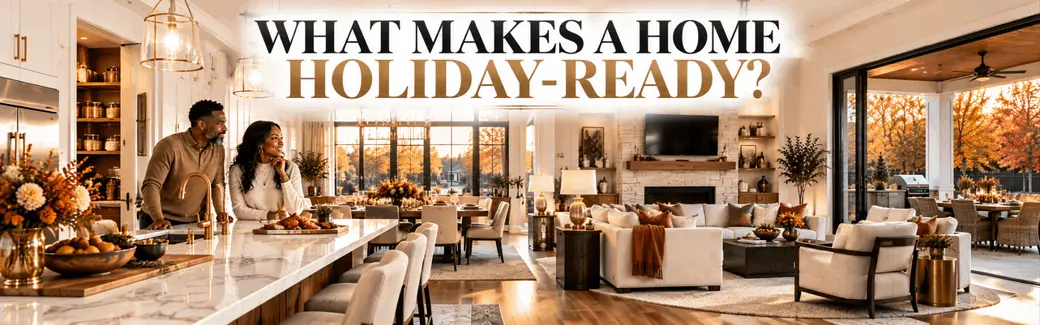
Hosting & Layout Hacks: What Makes a Home Holiday-Ready?
Picture the house on Thanksgiving afternoon.
Someone is pulling a casserole from the oven. Kids are moving between the living room and backyard. Family members are gathered around the kitchen island. Another group is watching the game. Cars are arriving in the driveway.
And somehow, everyone needs somewhere to sit.
Suddenly, the beautiful backsplash that caught your attention during the showing isn't the most important feature in the house.
The layout is.
When shopping for a home in South Metro Atlanta this fall, holiday entertaining offers buyers an interesting way to evaluate a property's functionality.
You don't need to host 30 people every Thanksgiving to benefit from a home that flows well.
A property that comfortably handles guests can also work better for everyday family life, birthday parties, graduation celebrations, neighborhood gatherings, remote work, multigenerational visits, and ordinary Saturday afternoons.
So during your next showing, look beyond the staging.
Ask yourself:
How would this house function when it's actually full of people?
1. Start With Kitchen-to-Living Flow
For many households, the kitchen becomes the unofficial command center during gatherings.
That's why buyers shouldn't evaluate the kitchen in isolation.
Instead, stand at the kitchen island or main preparation area and look around.
Can you see into the family room?
Can someone prepare food while still participating in conversation?
Does traffic naturally move around the cooking zone—or directly through it?
Is there enough circulation space when several people are standing around the island?
These questions can matter more than whether the countertops happen to be your favorite color.
Open Concept Isn't the Only Answer
A home doesn't need one enormous open room to entertain well.
Some buyers actually prefer separation between the kitchen, dining room, and living areas.
The more important question is flow.
A partially open kitchen with wide openings into adjacent rooms may function beautifully.
A completely open floor plan with awkward furniture placement or limited wall space may not.
Don't simply ask:
“Is it open concept?”
Ask:
“Does this layout work?”
2. Find the Holiday Traffic Jam
Here's one of my favorite showing exercises.
Imagine ten additional people inside the house.
Now mentally move them through it.
Where do coats go?
Where do people put bags?
Where do guests congregate when they first arrive?
Can someone open the refrigerator while another person is using the oven?
Can people reach the powder room without walking through private areas?
Can guests move from the kitchen to the dining space without everyone squeezing through one narrow passage?
This is how you uncover what I call the holiday traffic jam.
A floor plan may look impressive when perfectly staged and occupied by two people.
The real test is what happens when the house is being used.
3. Don't Ignore the Dining Space
Formal dining rooms aren't essential for every buyer.
But if hosting matters to you, identify where a larger meal would actually happen.
Maybe it's a traditional dining room.
Maybe it's a breakfast area capable of accommodating an expandable table.
Maybe the home has one large open dining zone adjacent to the kitchen.
Look at the physical space rather than the staged furniture.
Could the table expand?
Would additional chairs block a walkway?
Can guests move behind seated diners?
Is the dining space reasonably connected to the kitchen?
A room that technically fits a table doesn't necessarily function well for twelve dinner guests.
4. Evaluate the Kitchen Like a Host, Not Just a Buyer
Beautiful kitchens photograph well.
Functional kitchens host well.
If entertaining is important to you, pay attention to features such as usable counter space, pantry storage, appliance placement, cabinet capacity, island dimensions, circulation, and serving areas.
A double oven can be attractive for someone who regularly hosts large meals.
But don't automatically eliminate an otherwise excellent home because it doesn't have one.
Appliances may be changeable.
Layout limitations can be harder and more expensive to change.
A better hierarchy is:
FUNCTION → STORAGE → WORKSPACE → APPLIANCES → FINISHES
The quartz pattern should probably come after whether three people can comfortably work in the kitchen.
5. Pantry Storage Is an Entertaining Feature
Pantries don't receive the same attention as oversized islands.
But when a house is full, storage becomes valuable quickly.
Think about holiday groceries, serving platters, small appliances, beverages, paper products, bulk purchases, cookware, and items you don't want covering every countertop.
A walk-in pantry can be useful, but size alone isn't everything.
Evaluate shelving.
Depth.
Accessibility.
Door swing.
Lighting.
And whether the pantry's location actually supports how the kitchen functions.
Good storage doesn't just make Thanksgiving easier.
It can make every week of the year easier.
6. Check the Driveway Before You Check the Décor
The entertaining experience starts before guests walk through the front door.
Where will they park?
South Metro Atlanta properties can vary considerably in lot configuration, driveway design, garage placement, neighborhood rules, and street-parking practicality.
Don't assume a large-looking lot automatically means abundant guest parking.
During your showing, look at the driveway configuration.
Could additional vehicles reasonably fit without blocking garage access?
How difficult would it be for cars to enter and exit?
What happens when several households arrive simultaneously?
Is street parking permitted and practical?
Are there HOA or community restrictions that need to be verified?
Don't create your own parking rules based on what neighbors appear to be doing.
Verify restrictions that matter to your intended use.
7. Look for the “Second Gathering Zone”
This feature can dramatically change how a home feels during gatherings.
The main living room doesn't always need to accommodate everyone.
A second usable gathering area might be a bonus room, loft, finished basement, keeping room, media room, sunroom, covered patio, or upstairs flex space.
Think about Thanksgiving.
Adults may be talking in the kitchen.
Children might want somewhere else to play.
Someone may want to watch football.
Others may want a quieter conversation.
One enormous room isn't always the solution.
Sometimes multiple functional zones create a better experience.
This is also where layout versatility becomes valuable beyond the holidays.
Today's game room could become tomorrow's office.
A loft could become a study area.
A bonus room could evolve with your household.
That's why I encourage buyers to look for options rather than labels.
8. Don't Forget Overnight Guests
If family frequently visits from outside Metro Atlanta, entertaining isn't just about dinner.
Someone may be staying until Sunday.
Ask:
Where would overnight guests sleep?
Which bathroom would they use?
How much privacy would they have?
Would an older parent need to climb stairs?
Could a home office occasionally function as a guest room?
A main-level guest suite can be particularly useful for some households, but it's not necessary for everyone.
What matters is whether the floor plan supports your actual life.
For buyers planning to remain in a home for years, flexible guest accommodations can also support changing family needs.
9. Take the Party Outside—Even in Fall
Outdoor living shouldn't automatically disappear from your home search when temperatures cool.
A covered patio, screened porch, deck, fire-pit area, or protected seating zone can provide valuable overflow space during fall gatherings.
But evaluate the outdoor area realistically.
Is it directly accessible from the main entertaining space?
Is there a practical route between the kitchen and patio?
Is there enough usable surface for furniture?
How is the lighting?
Does the yard slope significantly?
Is the space exposed to weather?
Would exterior improvements require HOA approval, permits, or other verification?
A staged patio with four beautiful chairs isn't automatically a functional outdoor living space.
Think about how you would actually use it.
10. Find the Hidden Storage
Hosting creates stuff.
Extra chairs.
Folding tables.
Serving pieces.
Seasonal décor.
Coolers.
Holiday decorations.
Outdoor cushions.
Large cookware.
Table linens.
If entertaining is part of your lifestyle, don't leave the showing without checking where those things would live.
Look at closets.
Garage storage.
Pantry capacity.
Attic access.
Basement storage where applicable.
Laundry or utility rooms.
And unused areas that could reasonably accommodate organized storage.
A house can have impressive square footage and still feel cramped if storage is poorly designed.
11. Think About the Morning After Thanksgiving
This is the test almost nobody performs.
Everyone imagines the party.
Few people imagine cleanup.
Look at the kitchen again.
Where do dishes go?
How much counter space remains when the sink is full?
Is the dishwasher conveniently positioned?
Where does trash accumulate?
Is there an easy route to exterior trash storage?
Where would leftover food go?
Does the refrigerator have practical capacity for your household?
A holiday-ready house isn't only comfortable while guests are there.
It should also be manageable after everyone leaves.
12. Buyers: Don't Overpay for Someone Else's Holiday Fantasy
Fall staging can be extremely effective.
Candles.
Pumpkins.
Warm lighting.
A beautifully set dining table.
A fireplace glowing in the background.
It can make you imagine your entire future in the property.
Enjoy that feeling.
Then mentally remove everything the seller is taking with them.
Take away the table settings.
Take away the seasonal décor.
Take away the staged furniture.
Take away the flowers and candles.
What's left?
The architecture.
The room dimensions.
The storage.
The circulation.
The parking.
The outdoor space.
The functionality.
That's the house you're actually buying.
13. Investors: Think Beyond Cosmetic Renovations
Investors evaluating properties for resale or long-term rental can use the same framework.
It's easy to focus primarily on finishes:
New flooring.
New countertops.
Fresh paint.
Updated fixtures.
Those improvements may matter.
But a property's functional appeal can matter too.
Consider whether the home offers practical gathering space, usable kitchen circulation, adequate storage, flexible rooms, guest accommodations, outdoor living potential, and sensible parking.
You cannot assume those features will produce a specific resale premium or rental return.
Local comparable properties, buyer demand, property condition, location, financing environment, renovation costs, and other factors still need to be evaluated.
But here's the strategic idea:
Cosmetics can attract attention. Functionality can help buyers imagine living there.
The Holiday-Ready Home Test
At your next showing, don't just ask whether you like the house.
Run this simple test:
COOK
Can several people use the kitchen without creating chaos?
GATHER
Are there comfortable spaces for people to spend time together?
FLOW
Can guests move naturally between major areas?
PARK
Can the property reasonably accommodate visitors?
HOST
Are there flexible spaces for meals, conversation, children, or overnight guests?
STORE
Where do entertaining supplies and seasonal items go?
EXPAND
Can indoor living transition naturally into outdoor or secondary gathering areas?
ADAPT
Will these spaces still be useful when you're not hosting Thanksgiving?
If the answer to most of those questions is yes, you may be looking at something more valuable than a pretty house.
You may be looking at a functional home.
Holiday-Ready Doesn't Mean Holiday-Specific
Here's the larger lesson.
You're probably not buying a house solely for Thanksgiving.
Nor should you.
But Thanksgiving gives you a useful stress test for a floor plan.
A kitchen that functions with ten guests may be easier for everyday family dinners.
A flexible bonus room that entertains children during the holidays may become an office on Monday.
Guest parking can matter for birthdays and graduation parties.
A covered patio can become your Saturday-morning coffee spot.
A main-level guest room might eventually serve an aging parent.
A large pantry can improve daily organization.
The best entertaining features often aren't really entertaining features.
They're livability features.
FAQs
What home features are best for entertaining?
There isn't one perfect entertaining floor plan. Many buyers value good kitchen-to-living flow, practical dining space, usable storage, flexible gathering areas, guest parking, and indoor-outdoor connections. Your priorities should reflect how you actually entertain.
Do I need an open-concept house for hosting?
No. A partially open or more traditional layout can work extremely well when circulation between the kitchen, dining, and living areas is practical.
Is a double oven worth prioritizing?
It may be useful for buyers who cook frequently or host large meals, but it shouldn't necessarily outweigh more difficult-to-change features such as room dimensions, circulation, storage, and overall layout.
Should I consider guest parking when buying a house?
Yes, particularly if you entertain regularly. Evaluate the actual driveway and confirm applicable HOA, community, and local parking restrictions rather than assuming nearby street parking will always be available.
Does a good entertaining layout increase resale value?
It may broaden appeal to some buyers, but no individual layout feature guarantees a higher resale price or appreciation. Resale depends on the overall property, location, condition, comparable sales, market conditions, and buyer demand.
What should investors look for in an entertaining-friendly property?
Look beyond cosmetic finishes toward functional characteristics: kitchen circulation, storage, flexible rooms, parking, guest accommodations, and usable indoor-outdoor connections. Then compare those features against relevant local properties and your target buyer or tenant.
Don't Just Tour the House. Test the House.
Fall buyers have a unique opportunity.
The season naturally makes us think about gathering.
Family.
Food.
Friends.
Football.
Celebrations.
Instead of treating that as seasonal emotion, turn it into a strategic homebuying tool.
Walk through the property and imagine it under pressure.
Not perfectly staged.
Not completely quiet.
Not with every countertop empty.
Imagine groceries arriving.
Guests parking.
Children playing.
Food cooking.
Family staying overnight.
People moving between rooms.
And then ask:
Does this home make those moments easier—or harder?
Because you're not purchasing staged square footage.
You're purchasing the setting where your life will happen.
If you're searching for a home in Henry County or South Metro Atlanta this fall, let's look beyond countertops and staging and evaluate how each property actually fits the way you want to live.
From entertaining and flexible floor plans to storage, guest accommodations, outdoor living, and long-term functionality, we'll build your search around more than a wish list.
We'll build it around your life.
Contact Natasha Ewing Johnson today to schedule your complimentary Homebuyer Strategy Call.
Move Strategically. Live Abundantly.
This article is for general educational purposes. Property features, HOA requirements, parking restrictions, renovation feasibility, zoning, permits, resale performance, and investment results vary by property and location and should be independently verified where relevant.
Categories
Recent Posts