
The Investor “Split-and-Build” Play: How Metro Atlanta Land Investors Create Value From Subdividable Acreage
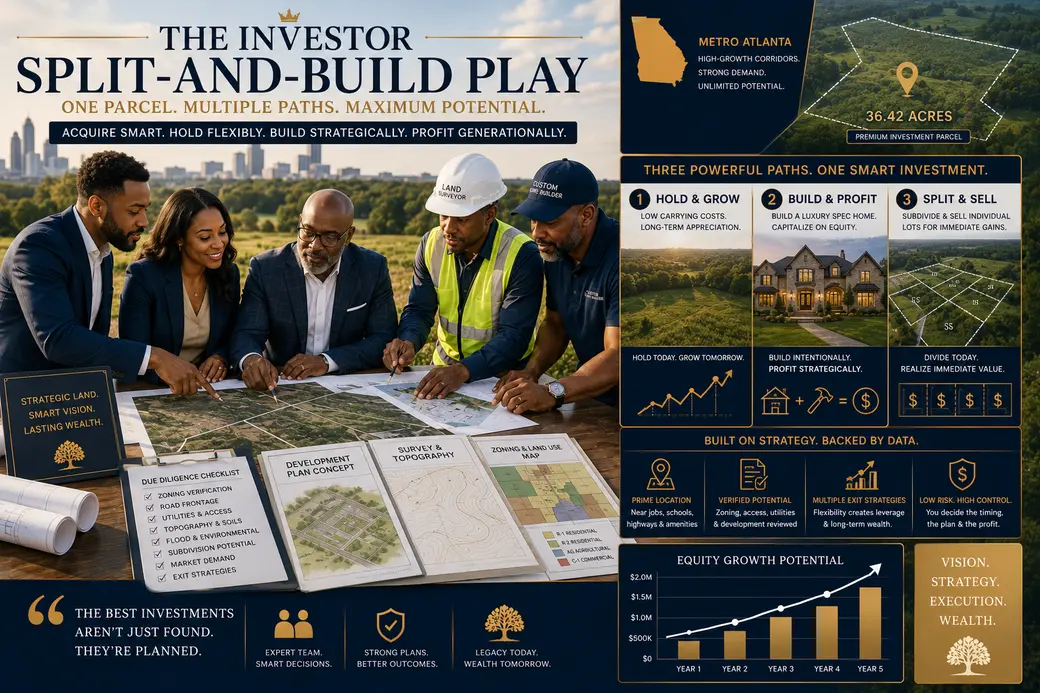
The Investor “Split-and-Build” Play: Turning Metro Atlanta Land Into Multiple Opportunities
For many real estate investors, the traditional formula has always been the same: buy a house, place a tenant, collect rent, and manage the property.
But rental ownership also comes with ongoing responsibilities—maintenance requests, vacancies, repairs, insurance, property management, and unexpected expenses.
That is why some investors are looking beyond existing homes and focusing on a different type of opportunity:
Strategically located land with multiple potential exit paths.
In high-growth corridors across Metro Atlanta, a well-selected parcel may offer investors the flexibility to hold the land, build a custom spec home when market conditions align, pursue subdivision approval, or sell individual lots to builders and developers.
This approach is known as the Investor Split-and-Build Play.
The goal is not simply to buy acreage.
The goal is to acquire land with verified development potential and create value through patience, planning, and strategic execution.
Why Investors Are Looking Beyond Traditional Rentals
Rental properties can provide long-term income, but they are active assets that require ongoing oversight.
Owners may be responsible for:
- Tenant turnover
- Property maintenance
- Emergency repairs
- HVAC and plumbing issues
- Insurance expenses
- Property management
- Renovations between tenants
- Vacancy periods
Raw land may have fewer day-to-day operational demands because there are no occupied structures to maintain.
However, land is not expense-free or automatically low-risk.
Investors may still need to account for:
- Property taxes
- Insurance
- Vegetation management
- Security or dumping concerns
- Surveying
- Soil testing
- Legal expenses
- Financing costs
- Development studies
The advantage is not that land requires no management. The advantage is that the right parcel may provide flexibility without the daily responsibilities associated with tenant-occupied property.
What Is the Split-and-Build Strategy?
The Split-and-Build Strategy focuses on purchasing land that may support more than one future use.
Depending on zoning, access, utilities, site conditions, market demand, and government approval, an investor may consider several potential paths.
Hold the Land
Secure the property and maintain it while monitoring future growth, infrastructure, housing demand, and development activity.
Build a Custom Spec Home
Construct a market-driven home designed for resale when timing, financing, and buyer demand support the project.
Pursue Subdivision
Explore whether the acreage can legally and physically be divided into multiple buildable lots.
Sell Individual Parcels
After completing the required subdivision and development process, sell approved lots to builders, developers, or future homeowners.
Sell the Entire Property
Market the land as one development opportunity when buyer demand and land value align with the investment strategy.
The strongest land investments often provide more than one realistic exit option.
Why Location Still Drives Land Value
Not all acreage is investment-grade land.
A large parcel in a weak location may have fewer development opportunities than a smaller property near employment centers, transportation routes, established neighborhoods, schools, retail, utilities, and planned growth.
Investors evaluating Metro Atlanta land should consider proximity to:
- Major highways
- Employment centers
- Distribution and logistics corridors
- Established residential communities
- New construction activity
- Shopping and dining
- Public utilities
- Major transportation routes
Growth can create opportunity, but future appreciation should never be treated as guaranteed.
The best strategy is to evaluate what the property can support under current conditions—not rely entirely on future development.
The Word “Subdividable” Must Be Verified
One of the biggest mistakes land investors make is assuming that a large parcel can automatically be divided.
It cannot.
Subdivision potential may depend on:
- Current zoning
- Minimum lot size
- Minimum lot width
- Road frontage
- Legal access
- Setbacks
- Utility availability
- Septic feasibility
- Soil conditions
- Topography
- Flood zones
- Wetlands
- Easements
- Stormwater requirements
- Local development standards
A listing description that says “potentially subdividable” is not the same as government approval.
Before purchasing, investors should verify the property’s development potential with the appropriate planning and zoning authority and qualified land-development professionals.
The First Layer: Zoning
Zoning determines how land may be used and developed.
Before evaluating future profit, confirm:
- The current zoning classification
- Permitted residential uses
- Minimum lot requirements
- Density limitations
- Building setbacks
- Road-frontage requirements
- Accessory-use restrictions
- Whether rezoning would be necessary
If the investment depends on a zoning change, evaluate the property based on its current zoning until a change is formally approved.
Rezoning is a public process and should never be assumed.
The Second Layer: Access and Road Frontage
A parcel may have significant acreage but limited development potential if it lacks adequate access.
Important questions include:
- Does the property have legal road access?
- How much public road frontage exists?
- Can multiple lots meet frontage requirements?
- Would a private road be required?
- Could road improvements be necessary?
- Are there shared-driveway agreements?
Access can significantly affect the number of lots a property may support and the cost of developing them.
A land investment is only as useful as the legal and practical ability to reach it.
The Third Layer: Water, Sewer, and Septic
Utility access can dramatically affect development costs.
Determine whether the property has access to:
- Public water
- Public sewer
- Private well options
- Septic systems
- Electricity
- Natural gas
- Internet infrastructure
If public sewer is unavailable, soil conditions and septic feasibility may influence the number, size, and placement of future homes.
A parcel that appears capable of supporting several lots may support fewer homes after soil testing, setbacks, easements, and septic requirements are considered.
Complete utility and site research early.
The Fourth Layer: Topography and Environmental Conditions
Flat, accessible land may be easier to develop than steep, heavily wooded, low-lying, or environmentally constrained property.
Potential site limitations include:
- Flood zones
- Streams
- Wetlands
- Steep slopes
- Drainage areas
- Protected buffers
- Unstable soil
- Significant grading requirements
These conditions do not automatically make a property unsuitable, but they may reduce usable acreage or increase development costs.
Investors should evaluate buildable land, not just total acreage.
Strategy One: The Long-Term Land Hold
Some investors purchase land with the intention of holding it while nearby development continues.
Potential advantages may include:
- Fewer tenant-related responsibilities
- Flexibility in timing
- Future development potential
- Multiple resale options
However, appreciation is not guaranteed.
A long-term hold should account for:
- Property taxes
- Financing costs
- Insurance
- Property maintenance
- Market changes
- Zoning changes
- Infrastructure timing
- Opportunity cost
The strongest hold strategy begins with land that has value under current conditions—not only under an optimistic future scenario.
Strategy Two: Build a Custom Spec Home
A spec home is built without a specific buyer already under contract.
The investor selects a floor plan, finishes, features, and price position based on expected market demand.
A successful spec-home strategy may require:
- Strong local buyer demand
- A realistic construction budget
- Experienced builders
- Construction financing
- Market-appropriate design
- Accurate resale projections
- Sufficient contingency reserves
Investors should also account for:
- Site preparation
- Permits
- Utility connections
- Architectural plans
- Engineering
- Landscaping
- Interest expenses
- Insurance
- Marketing
- Sales costs
The land purchase is only one part of the total investment.
Strategy Three: Divide and Sell Individual Lots
When legally approved and financially feasible, subdividing acreage may create multiple marketable parcels.
For example, one larger property may potentially become several individual lots.
However, the value is not created simply by drawing new lines on a map.
The subdivision process may require:
- Boundary surveys
- Concept plans
- Engineering
- Soil evaluations
- Utility planning
- Road improvements
- Stormwater planning
- Government review
- Plat approval
- Recording fees
Investors should calculate the full cost of creating approved, marketable lots before estimating potential profit.
Strategy Four: Sell to a Builder or Developer
Some investors do not want to manage construction.
Instead, they focus on acquiring land, improving its development position, and selling it to a builder or developer.
Potential value may come from reducing uncertainty through:
- Updated surveys
- Zoning verification
- Soil studies
- Utility research
- Concept plans
- Approved subdivision plats
- Clear development documentation
Builders often evaluate land based on risk, timing, projected home prices, infrastructure costs, and expected profit.
The more uncertainty an investor can responsibly remove, the easier the opportunity may be to evaluate.
The Importance of Multiple Exit Strategies
Land investments can take time.
Market conditions change. Construction costs shift. Interest rates move. Development approvals may take longer than expected.
That is why investors should avoid relying on one outcome.
Before purchasing, consider:
- Can I hold the land longer than expected?
- Can I sell the parcel without subdividing?
- Could I build one home instead of several?
- Is there demand from local builders?
- What happens if development costs increase?
- Does the property still have value if my preferred plan is not approved?
Flexibility can help reduce risk.
Build a Professional Due-Diligence Team
Land investing often requires more specialized research than purchasing an existing home.
Depending on the project, your team may include:
- A real estate professional experienced with land
- Planning and zoning staff
- A land-use attorney
- A surveyor
- A civil engineer
- A soil scientist
- A builder
- A lender
- A tax professional
- An insurance professional
The objective is to identify constraints before closing—not after the investment has been made.
The Investor’s Split-and-Build Checklist
Before purchasing a Metro Atlanta land investment, verify:
- Current zoning
- Permitted land uses
- Minimum lot requirements
- Road frontage
- Legal access
- Utility availability
- Soil and septic feasibility
- Topography
- Flood-zone status
- Wetlands and stream buffers
- Easements
- HOA or private restrictions
- Development approval requirements
- Estimated infrastructure costs
- Builder and buyer demand
- Holding expenses
- Multiple exit strategies
A strong investment begins with verified information.
Final Thoughts
For investors who want alternatives to traditional rental ownership, raw land may offer a different path.
A strategically located parcel can become a long-term hold, a future custom-home site, a potential subdivision project, or an opportunity for builder acquisition.
But acreage alone does not create value.
The real opportunity comes from understanding zoning, access, utilities, buildability, market demand, and development costs before making the purchase.
The Investor Split-and-Build Play is not about buying the biggest piece of land available.
It is about finding a property with verified potential, manageable risk, and multiple ways to create value over time.
Call to Action
Looking for land with investment, custom-building, or potential subdivision opportunities in Metro Atlanta?
I can help you identify properties that align with your strategy and connect you with the appropriate zoning, surveying, engineering, lending, legal, and construction professionals for further evaluation.
Let’s find land that supports more than one possibility—and build an investment strategy around verified potential.
Frequently Asked Questions
Is raw land a passive investment?
Land may involve fewer day-to-day responsibilities than tenant-occupied property, but it still requires oversight and may include taxes, financing costs, insurance, maintenance, research, and development expenses.
Can any large property be subdivided?
No. Subdivision potential depends on zoning, minimum lot standards, frontage, access, utilities, septic feasibility, environmental conditions, and government approval.
What is a spec home?
A spec home is generally built without a specific buyer already under contract. The builder or investor selects the design based on anticipated market demand.
Is land cheaper to carry than a rental property?
It may have fewer operating expenses because there is no occupied structure, but carrying costs vary. Investors should calculate taxes, financing, insurance, maintenance, and opportunity costs before purchasing.
Can I sell individual lots immediately after buying acreage?
Not necessarily. The property may require surveying, subdivision approval, engineering, utility planning, plat recording, or other development work before individual parcels can be legally sold.
What should I verify before buying land in Metro Atlanta?
Confirm zoning, access, road frontage, utilities, soil conditions, topography, flood zones, easements, development requirements, market demand, and estimated project costs.
Categories
Recent Posts