
Seller-Paid 2-1 Rate Buydowns vs. Price Reductions: Which Saves Homebuyers More?
Leverage Interest Rate Buy-Downs Over Price Reductions: Make the Seller's Concession Work Harder
When negotiating a home purchase, most buyers instinctively ask for one thing:
"Can we get the seller to lower the price?"
Sometimes that's exactly the right strategy.
But if your immediate priority is reducing your monthly housing expense during the first years of homeownership, there's another negotiation tool worth discussing with your lender: a seller-funded temporary interest rate buydown.
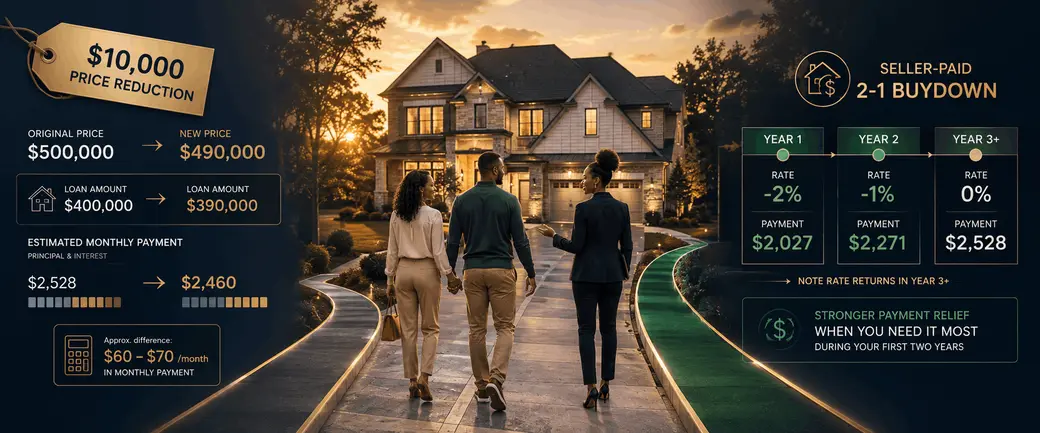
A $10,000 price reduction might lower the principal-and-interest payment by only several dozen dollars per month, depending on the loan amount, rate, and term. That same negotiation value, when permitted and sufficient to fund a 2-1 temporary buydown, could create a much larger payment reduction during Years 1 and 2.
The important question isn't simply:
"How much can I get the seller to give me?"
It's:
"How should I structure that concession to best accomplish my financial goals?"
What Is a 2-1 Temporary Rate Buydown?
A 2-1 buydown temporarily reduces the interest rate used to calculate your mortgage payment during the first two years.
For example, if your mortgage has a 6.5% note rate, a traditional 2-1 structure could result in payments calculated approximately as though the rate were:
Year 1: 4.5%
Year 2: 5.5%
Year 3 onward: 6.5%
The mortgage's actual note rate does not permanently change. Funds placed into the buydown arrangement subsidize the difference in payments during the temporary period.
That distinction matters.
A 2-1 buydown is not the same thing as permanently buying down your mortgage rate with discount points.
Why a $10,000 Price Reduction May Not Change Your Payment Much
Here's where buyer psychology can work against you.
A $10,000 reduction sounds substantial because $10,000 is substantial.
But if you're financing most of the purchase, that $10,000 reduction is spread across a long mortgage term.
Consider a simplified hypothetical example.
Scenario A: $500,000 Purchase
Assume:
Purchase price: $500,000
Down payment: 20%
Loan amount: $400,000
Illustrative fixed rate: 6.5%
Term: 30 years
Principal and interest would be approximately $2,528 per month.
Now imagine negotiating the home to $490,000 while keeping the same 20% down structure.
The hypothetical loan becomes approximately $392,000.
Principal and interest would be approximately $2,478 per month.
That's roughly a:
$50 monthly principal-and-interest difference.
The lower price still has real benefits. You borrow less, potentially contribute less cash toward the percentage-based down payment, and pay less principal and interest over time.
But the immediate monthly-payment impact may be smaller than buyers expect.
Now Compare That With a 2-1 Buydown
Let's return to the hypothetical $400,000 mortgage with a 6.5% note rate.
A traditional 2-1 temporary buydown would make the payment behave approximately like this:
Year 1 — Payment Based on 4.5%
Approximate principal and interest:
$2,027/month
Compared with approximately $2,528 at the full note rate, that's about:
$501 less per month
during the first year.
Year 2 — Payment Based on 5.5%
Approximate principal and interest:
$2,271/month
That's approximately:
$257 less per month
than the full-rate payment.
Year 3 and Beyond
The subsidy ends and the borrower makes the full payment based on the 6.5% note rate:
Approximately $2,528/month.
These numbers are illustrative only and exclude taxes, insurance, HOA dues, mortgage insurance, and other housing expenses.
The Difference Is Cash-Flow Timing
This is the strategic distinction.
A price reduction generally creates a smaller benefit stretched over the life of the mortgage.
A temporary buydown concentrates its benefit into the first years of ownership.
That can be valuable because moving into a new home frequently comes with additional expenses:
- Furniture
- Moving expenses
- Window treatments
- Landscaping
- Appliances
- Minor repairs
- Emergency reserves
- Childcare changes
- Commuting adjustments
Reducing the mortgage payment during that transition period may give some buyers additional breathing room.
But Don't Assume $10,000 Automatically Buys a 2-1
This is important.
The exact cost of a 2-1 buydown depends on the actual mortgage amount, note rate, amortization, loan program, and buydown structure.
So don't tell a seller:
"Give me $10,000 and I'll get a 2-1 buydown."
Instead, work with the lender first.
Ask:
"What is the exact cost to fund a 2-1 temporary buydown on this loan?"
Then structure the purchase offer accordingly.
Seller Credits Have Limits
Seller concessions aren't unlimited.
For conventional mortgages eligible for purchase by Fannie Mae, seller and other interested-party contributions are subject to financing-concession limits based on occupancy and loan-to-value ratios. The cost of a temporary or permanent rate buydown funded by an interested party is included when calculating those limits.
Loan programs can have different rules.
That's why your Realtor and lender need to coordinate before the offer is written, not after you've negotiated a concession you can't fully use.
Here's Another Important Detail: You Still Have to Qualify
A temporary buydown should not be used to stretch into a home you otherwise can't afford.
For Fannie Mae loans subject to temporary interest-rate buydowns, borrowers must qualify without relying on the temporarily reduced rate. Freddie Mac similarly requires qualifying fixed-rate borrowers using the payment calculated at the note rate.
In other words:
The lender isn't pretending your permanent payment is lower.
You need to demonstrate the ability to handle the full payment after the temporary subsidy expires.
That's an important consumer protection—and an important budgeting reality.
When a Price Reduction May Be Better
I'm not suggesting buyers should always choose a buydown.
A lower purchase price can be strategically stronger when:
- You expect to own the home for many years
- You want to minimize the amount borrowed
- The property appears overpriced
- Appraisal risk is a concern
- Your cash flow is already comfortable
- You want permanent rather than temporary savings
- The seller won't provide allowable financing concessions
- The loan program doesn't accommodate the proposed buydown
Remember:
You keep the lower purchase price permanently.
The temporary buydown eventually expires.
When a 2-1 Buydown May Be More Attractive
A temporary buydown may deserve serious consideration when:
- The home is appropriately priced
- The seller is willing to provide concessions
- You want greater payment relief immediately after closing
- Your income is expected to comfortably support the full future payment
- You want to preserve more cash during your first two years
- Your lender confirms the structure works with your mortgage program
This is where negotiation becomes strategy rather than simply asking for money off the house.
What About Refinancing Later?
Buyers sometimes hear:
"Use the buydown now and refinance when rates drop."
Be careful with that statement.
Mortgage rates may decline.
They may also remain elevated or increase.
Refinancing is never guaranteed.
Future refinancing depends on factors such as:
- Interest rates
- Home value
- Equity
- Credit
- Income
- Employment
- Debt-to-income ratio
- Loan availability
- Closing costs
Your purchase should make financial sense without depending on a future refinance.
If refinancing becomes advantageous later, consider it a potential opportunity—not the foundation of your affordability plan.
Think Beyond "How Much Off the Price?"
This is the conversation sophisticated buyers should be having.
Instead of:
"Can we get $10,000 off?"
Ask:
"What could $10,000 accomplish?"
Depending on the transaction, that negotiation value might potentially be used toward:
Option 1: Purchase-price reduction
Option 2: Closing-cost assistance
Option 3: Temporary rate buydown
Option 4: Permanent discount points
Option 5: A permitted combination of concessions
The best answer depends on your loan, financial position, expected ownership timeline, seller motivation, and lender guidelines.
Ask Your Lender for a Side-by-Side Comparison
Before deciding how to negotiate, request actual numbers.
Ask your lender to model:
Scenario A
Full asking price with no concession.
Scenario B
Reduced purchase price.
Scenario C
Full price with a seller-funded 2-1 temporary buydown.
Scenario D
Full price with allowable seller credits applied toward closing costs or another permitted financing strategy.
Then compare:
- Cash required at closing
- Year 1 payment
- Year 2 payment
- Year 3 payment
- Total interest implications
- Loan balance
- Break-even considerations
- Long-term ownership cost
Now you're negotiating based on mathematics rather than emotion.
A Smarter Offer Isn't Always the Lowest Offer
This is where experienced buyer representation can create value.
Suppose a seller cares strongly about maintaining the headline purchase price but is willing to negotiate concessions.
A buyer who understands financing may be able to structure an offer that satisfies the seller's priorities while creating a better short-term financial outcome for the buyer.
That's not about "winning" against the seller.
It's about finding terms that work for both sides.
Final Thoughts
The purchase price gets most of the attention in a real estate negotiation.
But terms matter too.
A $10,000 price reduction and a $10,000 seller concession are not financially identical.
Depending on your mortgage and personal goals, a properly structured temporary rate buydown could create significantly greater payment relief during your first years of homeownership.
The right strategy isn't automatically:
"Get the price lower."
It's:
"Make every negotiated dollar work as hard as possible."
Before writing your offer, talk with your lender, understand the available financing options, and decide which concession structure best supports your short- and long-term financial goals.
Buying a home in Metro Atlanta and wondering whether to negotiate the price, closing costs, or a rate buydown?
Let's build the offer around your total financial strategy, not just the listing price. Working alongside your lender, we can compare different seller-concession scenarios and determine which negotiation structure gives you the strongest combination of affordability, cash preservation, and long-term value.
Mortgage programs, rates, seller-contribution limits, and qualification requirements vary. All examples above are illustrative; obtain personalized loan estimates and guidance from a licensed mortgage professional.
Frequently Asked Questions
What is a 2-1 mortgage rate buydown?
A 2-1 temporary buydown reduces the payment calculation by two percentage points during the first year and one percentage point during the second year before returning to the full note-rate payment in Year 3.
Does a 2-1 buydown permanently lower my mortgage rate?
No. It temporarily subsidizes your payment. The underlying note rate remains in place.
Can a seller pay for a 2-1 buydown?
Potentially, yes, subject to the mortgage program, lender requirements, and applicable seller-contribution limits. Fannie Mae treats interested-party-funded buydown costs as part of its financing-concession calculation.
Is a rate buydown better than lowering the purchase price?
Not always. A buydown may create larger short-term monthly-payment relief, while a lower purchase price provides permanent benefits. Your lender can model both options.
Do I qualify using the reduced Year 1 payment?
For Fannie Mae loans with temporary buydowns, qualification does not rely on the bought-down rate; Freddie Mac likewise requires qualifying fixed-rate borrowers at the note-rate payment.
What happens after the second year?
With a standard 2-1 structure, the temporary subsidy ends and the borrower begins making the full payment associated with the mortgage's note rate.
Categories
Recent Posts