How Warehousing Growth in Locust Grove Impacts Residential Land Values
The Logistics Expansion: How Warehousing Growth in Locust Grove Impacts Residential Land Valuations
Drive through Locust Grove and one thing becomes clear: location means something very different depending on which side of the growth line you're standing on.
The area's access to I-75 makes it strategically attractive for logistics, distribution, commercial development, and employment. Local planning documents have historically identified industrial and warehouse uses around transportation infrastructure while also anticipating residential and commercial growth in other portions of the area. Henry County planning documents likewise recognize industrial growth and commercial expansion along the I-75 corridor.
For land buyers, however, the opportunity isn't simply finding acreage near economic growth.
It's understanding the separation barrier between land benefiting from that growth and land experiencing the negative externalities that can accompany it.
That distinction can dramatically change how a residential parcel should be evaluated.
The Warehouse Next Door Isn't the Investment Thesis
When investors hear that logistics companies, warehouses, or distribution facilities are expanding nearby, the immediate assumption can be:
"Jobs are coming, so nearby residential land must become more valuable."
Not necessarily.
Economic development can support housing demand by creating employment, infrastructure investment, services, and commercial activity.
But industrial development can also introduce:
- Truck traffic
- Noise
- Lighting
- Large-building views
- Road congestion
- Loading activity
- Industrial zoning transitions
The investment opportunity may therefore exist near the logistics corridor without necessarily being adjacent to it.
That's the distinction sophisticated land buyers should understand.
Why Locust Grove Attracts Logistics Development
Locust Grove's position along I-75 creates obvious transportation advantages.
Historical city planning documents describe industrial areas as appropriate for warehouses and distribution facilities where sites have access to I-75, railroads, utilities, and room for expansion. Those same planning documents specifically discuss maintaining truck routes that minimize intrusion into residential areas and buffering surrounding neighborhoods.
That tells investors something important.
Industrial growth and residential growth don't have to be mutually exclusive.
But land-use separation matters.
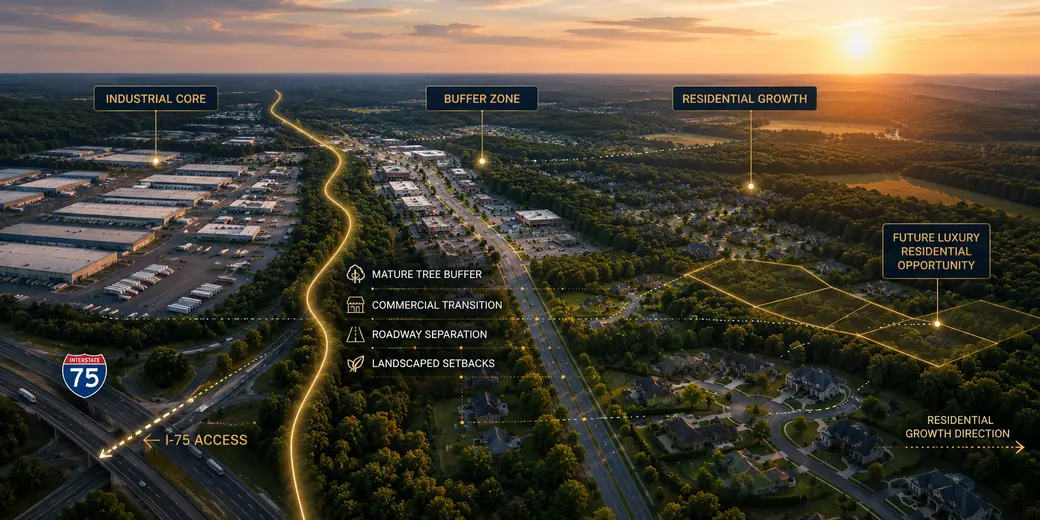
Think in Rings, Not Miles
A common mistake in land investing is measuring everything by distance.
"This parcel is only two miles from the industrial development."
That doesn't tell me enough.
I want to know:
What happens during those two miles?
A property could be geographically close to employment growth while being separated by:
- Major roadways
- Commercial corridors
- Tree buffers
- Topography
- Open space
- Other developments
- Planned mixed-use districts
Another property could be farther away but sit directly on a truck route.
That's why investors should think in impact rings rather than simple radius circles.
Ring 1: Direct Industrial Exposure
This is the highest-caution zone for a residential land investor.
Think parcels directly adjacent to or across from:
- Distribution centers
- Warehouse complexes
- Truck entrances
- Loading facilities
- Industrial-zoned acreage
The property may still have value.
It simply may have a different highest-and-best-use story than luxury residential development.
Before assuming residential appreciation, investigate the surrounding zoning and future land-use designations.
Ring 2: The Transition Zone
This is where things become interesting.
Between heavy industrial areas and established residential neighborhoods, you may find:
- Commercial uses
- Mixed-use areas
- Lower-intensity employment
- Transitional parcels
- Undeveloped acreage
This zone can act as a physical and functional buffer.
For residential land investors, the question becomes:
Is this transition zone strong enough to protect the residential experience?
If yes, the parcel may gain access to nearby economic activity without absorbing all of its disadvantages.
Ring 3: Residential Growth With Employment Access
This is often where the residential thesis becomes stronger.
Imagine a neighborhood that provides convenient access to:
I-75.
Employment centers.
Shopping.
Restaurants.
Schools and community amenities.
But residents aren't looking at loading docks from their backyards.
That's a very different proposition.
The goal isn't necessarily maximum distance from development.
It's convenient access with appropriate separation.
Ring 4: Premium Residential Growth
High-end residential buyers generally care about more than commute time.
They may also value:
- Larger lots
- Privacy
- Attractive streetscapes
- Lower through-traffic
- Mature landscaping
- Architectural consistency
- Recreational amenities
- Quiet outdoor living
A parcel's investment potential therefore depends partly on whether future development around it protects those characteristics.
That makes zoning research essential.
The Truck Route Test
Here's one of the first questions I'd ask when evaluating residential acreage near a logistics corridor:
Where will the trucks go?
Not where the warehouse sits.
Where the trucks travel.
Henry County transportation planning has specifically recognized conflicts that can occur when freight-intensive uses sit near residential development and notes the importance of separating incompatible uses.
For an investor, that means examining:
- Interstate access
- Major arterials
- Distribution entrances
- Planned road improvements
- Intersection changes
- Freight routes
- Future transportation projects
A beautiful parcel on a road that later becomes a major freight connector could experience a very different residential outcome.
The Buffer Test
Next ask:
What's between my parcel and the industrial use?
A quality buffer might include:
Dense vegetation
Meaningful setback
Commercial transition
Roadway separation
Topographic change
Open space
Purpose-built landscaping
The City's historical planning guidance specifically calls for buffering surrounding neighborhoods and controlling industrial impacts near residential areas.
That's not a guarantee of future value.
But it tells you that buffers are a legitimate planning consideration—not simply an aesthetic preference.
The Future Land-Use Map Matters More Than Today's View
This is where land investors frequently get caught.
You visit the property today.
Behind it is:
Trees.
Across the street is:
Vacant acreage.
Down the road is:
Farmland.
Perfect.
Except vacant land isn't a permanent land use.
Before buying, research what surrounding parcels can potentially become.
The City of Locust Grove currently provides access to planning resources including its Future Land Use Map and zoning information through its Community Development Department.
Locust Grove Community Development & Planning Resources
For properties outside city limits, Henry County Planning & Zoning provides comprehensive land-use and zoning resources.
Henry County Planning & Zoning
Those should be part of your land-investment due diligence.
Today's Residential Parcel Could Be Tomorrow's Transition Parcel
Suppose you find ten acres currently surrounded by low-density residential uses.
That sounds promising.
But then you discover:
A large neighboring tract has an industrial future-land-use designation.
Another parcel has a rezoning application.
A roadway expansion is planned nearby.
Suddenly, the investment thesis changes.
That's why investors shouldn't simply ask:
"What's here?"
Ask:
"What's legally and politically possible around here?"
Follow the Transportation Investment
Infrastructure frequently provides clues about where growth pressure may increase.
Locust Grove says it is working on improvements involving Market Place Boulevard, SR 42, and Bill Gardner Parkway around the I-75 interchange, while longer-range transportation planning also considers freight, vehicle, pedestrian, and bicycle mobility.
For investors, road projects deserve attention because they can change:
Accessibility.
Traffic patterns.
Development feasibility.
Commercial visibility.
Residential desirability.
But infrastructure doesn't automatically increase every nearby property's value.
Again, location within the growth pattern matters.
Employment Growth Can Create Residential Demand—But Don't Overstate It
Warehousing and logistics facilities create jobs.
Those jobs can contribute to local housing demand.
Additional employment can also encourage supporting development such as restaurants, services, retail, and infrastructure.
But it would be overly simplistic to claim:
New warehouse = residential appreciation.
Property values are influenced by many factors, including:
- Supply
- Demand
- Interest rates
- Schools
- Infrastructure
- Zoning
- Home quality
- Lot size
- Neighborhood characteristics
- Taxes
- Economic conditions
Treat logistics expansion as one demand signal, not a guaranteed appreciation formula.
The Luxury Residential Question
For investors considering high-end residential land, I would ask a different question:
Can the eventual homeowner enjoy the economic benefits of Locust Grove without feeling like they live inside a logistics corridor?
That's the premium.
Imagine two parcels.
Parcel A
Closer to I-75.
Excellent transportation access.
But visible warehouses, heavy trucks, and limited residential buffering.
Parcel B
Several minutes farther away.
Still convenient to I-75 and employment.
But positioned behind established residential development with mature trees and lower through-traffic.
For a luxury residential strategy, Parcel B could potentially have the stronger buyer story—even if Parcel A looks better on a map.
Don't Forget the Industrial Parcel Opportunity
Sometimes your research reveals something unexpected.
You started looking for residential acreage.
But the surrounding future land uses, transportation access, utilities, and development pattern suggest the parcel may eventually be more valuable for another purpose.
Don't force a residential strategy onto land simply because that's why you originally found it.
Ask:
What is the property's realistic highest and best use?
That answer requires professional analysis and may involve planners, engineers, attorneys, brokers, appraisers, and other specialists.
The Locust Grove Land Investor's 7-Layer Map
Before purchasing acreage, I would build seven layers of information.
Layer 1 — Current Zoning
What can legally be developed today?
Layer 2 — Future Land Use
What does the jurisdiction envision for the area?
Layer 3 — Industrial Development
Where are existing and proposed warehouse or logistics concentrations?
Layer 4 — Transportation
Where are interstate connections, truck routes, road expansions, and major intersections?
Layer 5 — Utilities
Where are water, sewer, electricity, and other infrastructure available?
Layer 6 — Residential Growth
Where are new subdivisions, higher-end neighborhoods, and residential permits concentrating?
Layer 7 — Physical Buffers
Where are streams, trees, topography, roads, commercial areas, and open spaces creating separation?
Now you're not simply buying dirt.
You're buying a position within a development pattern.
Watch Planning Meetings, Not Just Listings
Some of the most valuable land intelligence never appears in an MLS description.
Investors should monitor:
- Rezoning applications
- Planning commission agendas
- City council agendas
- Annexations
- Development of Regional Impact filings where applicable
- Road projects
- Comprehensive plan updates
- Future land-use amendments
Locust Grove's Community Development page notes that comprehensive planning work has been underway, making current planning documents especially important to verify before relying on older maps or studies.
That means always confirm the latest adopted information before investing.
A Simple Land Scoring Model
When evaluating a residential parcel near logistics development, consider scoring it from 1–5 across:
| Factor | Question |
|---|---|
| Industrial Separation | How protected is the parcel from industrial activity? |
| Truck Exposure | Will freight traffic affect the residential experience? |
| Interstate Access | Is I-75 convenient without being intrusive? |
| Residential Momentum | Is quality housing expanding nearby? |
| Future Land Use | Do surrounding designations support the thesis? |
| Infrastructure | Can the site realistically support development? |
| Buffer Quality | Are meaningful natural or built buffers present? |
| Exit Flexibility | Could the parcel support more than one viable strategy? |
The score isn't an appraisal.
It's a way to force disciplined thinking before emotion takes over.
The Real Investment Opportunity Is the Boundary
This is the central idea.
The most interesting land may not sit directly inside the fastest-growing industrial district.
It may sit along the boundary where economic growth transitions into desirable residential living.
Close enough to benefit from:
Jobs.
Infrastructure.
Interstate access.
Retail growth.
But separated enough to preserve:
Privacy.
Quiet.
Residential character.
Lifestyle appeal.
That separation can become part of the property's value proposition.
Final Thoughts
Locust Grove's logistics story creates opportunities—but it also creates land-use complexity.
Industrial expansion doesn't automatically make every nearby residential parcel more valuable.
The smarter question is:
Where does logistics growth stop and premium residential growth begin?
Study zoning.
Study future land use.
Map truck routes.
Track transportation projects.
Identify buffers.
Watch rezoning activity.
Then evaluate the parcel based on where it sits within that larger development ecosystem.
Because in a rapidly changing market, you're not simply investing in the acreage you see today.
You're investing in what could surround it tomorrow.
Considering land in Locust Grove or South Henry County?
Before you evaluate acreage solely by price per acre, let's build a Land Positioning Map around the property—identifying industrial zones, residential growth areas, transportation corridors, surrounding land uses, and potential buffers.
Then bring in the appropriate planning, engineering, legal, appraisal, and development professionals before making the final investment decision.
The goal isn't simply to buy land near growth. It's to buy on the right side of growth.
Frequently Asked Questions
Does warehouse development increase home values in Locust Grove?
Not automatically. Logistics development can contribute jobs, infrastructure, and economic activity, but proximity can also introduce truck traffic, noise, congestion, and incompatible land uses. Property-specific analysis is necessary.
Is land near I-75 a good investment?
I-75 access can be valuable for many uses, but the investment case depends on zoning, future land use, utilities, access, surrounding development, and the intended exit strategy.
How can I check the zoning of land in Locust Grove?
Start with the City of Locust Grove Community Development resources for property within the city and Henry County Planning & Zoning for applicable county properties. Always confirm current zoning directly with the relevant jurisdiction before relying on a third-party listing.
What should residential investors look for near warehouse developments?
Evaluate truck routes, noise and light exposure, setbacks, natural buffers, surrounding zoning, future land-use designations, road projects, utilities, and nearby residential development.
Are vacant woods next to a property a permanent buffer?
No. Unless protected or otherwise restricted, undeveloped property could potentially be developed later subject to zoning and approvals. Research ownership, zoning, and future land-use designations.
Can I predict which Locust Grove parcels will appreciate most?
No. Future appreciation cannot be guaranteed. Land values depend on numerous market, regulatory, physical, and economic factors.
Categories
Recent Posts