
Henry County Senior Tax Exemptions: How Property-Tax Savings Can Make Downsizing More Affordable
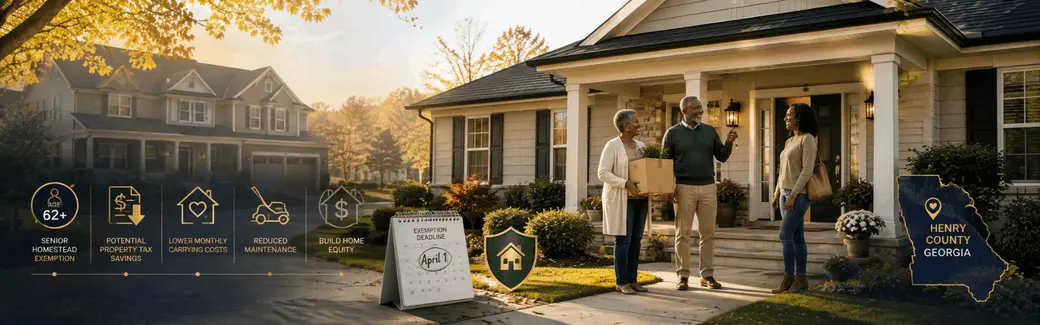
How Henry County Senior Tax Exemptions Can Slash the Carrying Cost of Downsizing
When most homeowners think about downsizing, they focus on the obvious numbers:
How much can I sell my current home for?
How much will my next home cost?
But for homeowners approaching retirement, there's another number that deserves just as much attention:
What will the next home cost me every month after I buy it?
Property taxes are an important part of that calculation.
Henry County offers local homestead exemptions tied to age, with the county's application identifying exemption levels beginning at age 62 and additional age categories at 65, 68, and 70. Eligibility and the actual tax impact depend on the exemption involved and the homeowner's circumstances.
For homeowners thinking about downsizing in McDonough, Stockbridge, Hampton, or Locust Grove, understanding these exemptions can change the math behind the move.
Downsizing Isn't Just About Buying a Smaller House
Imagine selling a large family home after 20 or 30 years.
The mortgage may already be paid off—or close to it.
At first, purchasing another home can feel counterintuitive.
Why move?
The answer often isn't simply square footage.
It's about reducing the cost and responsibility of ownership.
That means comparing:
- Property taxes
- Insurance
- Utilities
- Landscaping
- Maintenance
- Repairs
- HOA dues
- Accessibility
- Long-term upkeep
A smaller home that costs less to operate can potentially free up money for retirement, travel, family, investing, healthcare planning, or simply greater financial flexibility.
Henry County Has Age-Based Homestead Exemptions
This is where local knowledge becomes important.
Henry County's homestead-exemption application currently identifies county age-exemption categories for qualifying homeowners at:
Age 62
Age 65
Age 68
Age 70
The application uses separate exemption codes for these age levels, meaning homeowners shouldn't assume that turning 62 is the end of the conversation. Additional exemptions may become relevant as they get older.
That makes property-tax planning something worth revisiting throughout retirement.
Important: "Age 62" Does Not Automatically Mean "No School Taxes"
This distinction is extremely important.
You may hear people casually say:
"Once you turn 62, you don't have to pay school taxes anymore."
Don't build a downsizing budget around that assumption.
Senior exemptions can have specific eligibility requirements, exemption amounts, taxing components, and application procedures.
The amount one homeowner saves may not be the amount another homeowner saves.
Before purchasing a home based on projected tax savings, verify your eligibility and expected tax treatment directly with the Henry County Tax Assessor.
Henry County Homestead Exemption Information
Why This Matters So Much for Downsizers
Consider a homeowner deciding between two properties.
Home A
Larger property
More yard
Higher insurance
Higher utilities
More maintenance
Home B
Smaller single-level property
Lower utility usage
Manageable yard
Less maintenance
Potential senior homestead benefits
Most people compare the purchase prices.
But the better retirement question is:
"What does each home cost me to carry every year?"
That's a completely different analysis.
Think in Monthly Carrying Cost
Property taxes are typically discussed annually.
Retirees often experience them monthly through an escrow payment—or need to reserve money monthly even when taxes are paid directly.
Suppose an eligible exemption reduced a homeowner's property-tax liability by a hypothetical $2,400 annually.
That's equivalent to:
$200 per month.
A hypothetical $3,600 annual reduction represents:
$300 per month.
Those figures are examples only, not estimates of Henry County exemption savings.
Your actual savings must be calculated using the property's assessment, applicable millage rates, exemption eligibility, and taxing jurisdiction.
But this illustrates why property-tax planning matters.
A few hundred dollars in monthly carrying-cost differences can materially affect a retirement budget.
Don't Use the Seller's Tax Bill as Your Future Tax Bill
This is one of the most important lessons for downsizing buyers.
You find the perfect ranch home.
You review the listing.
The seller's property taxes look extremely attractive.
Great, right?
Not necessarily.
The seller may have exemptions that you don't qualify for.
Or the reverse could happen.
The current owner may not qualify for an exemption that you could potentially receive.
That's why historical property taxes should never be treated automatically as your future tax obligation.
Before making a decision, ask:
"What might the taxes look like based on my ownership and exemption status?"
Homestead Exemptions Generally Require the Home to Be Your Primary Residence
These benefits aren't simply attached to the property.
Homestead exemptions are tied to qualifying ownership and occupancy requirements.
Henry County's application states that the applicant must be the bona fide owner and occupy the property as of January 1 of the year for which the exemption is claimed. The application also requests documentation such as Henry County voter registration, vehicle registration, and a Henry County driver's license or ID.
That's especially important for people relocating into Henry County.
If you're purchasing late in the year, ask the Tax Assessor how your closing date affects when you can qualify and apply.
Watch the Application Deadline
Tax exemptions don't necessarily appear automatically because you celebrated a birthday.
You need to make sure the proper application is completed.
Henry County's published application instructions state that applications must be received or U.S. postmarked by April 1 for processing in that tax year.
That makes the calendar important.
If you're downsizing near retirement, property-tax planning should happen before closing, even if the application itself occurs later.
Put the exemption deadline on your post-closing checklist.
Build a "Retirement Carrying Cost" Comparison
When helping a downsizing homeowner evaluate properties, don't stop at purchase price.
Create a side-by-side comparison.
For each home, evaluate:
Housing
Mortgage payment, if applicable
Property taxes
Homeowners insurance
HOA dues
Utilities
Electricity
Natural gas
Water/sewer
Internet
Maintenance
Lawn care
Pest control
HVAC maintenance
Exterior maintenance
Roof expectations
Lifestyle
Stairs
Accessibility
Driving requirements
Proximity to family
Medical services
Shopping
Recreation
Then investigate any applicable senior tax exemptions separately.
Now you're comparing homes based on retirement economics, not just listing prices.
The Ranch Home Premium May Make More Sense Than It Appears
Downsizers frequently gravitate toward single-story homes.
And sometimes those homes command a premium.
At first glance, a ranch priced slightly higher than a comparable two-story property may appear like the worse financial choice.
But consider the entire picture.
A well-designed single-level home may offer:
- Easier mobility
- Fewer stairs
- Main-level laundry
- Easier maintenance
- Long-term accessibility
- Better aging-in-place potential
- Less unused space
Combine that with potentially lower utilities, reduced maintenance, and qualifying tax exemptions, and the long-term financial equation can look different.
Don't judge the move based solely on price per square foot.
Downsizing Can Be an Equity Strategy
Many long-term Henry County homeowners have built substantial home equity.
Selling a larger property and purchasing a smaller home may allow some homeowners to:
Reduce or eliminate mortgage debt.
Create additional liquid reserves.
Lower recurring housing expenses.
Simplify maintenance.
Reposition assets for retirement.
But releasing equity while moving into a property with unnecessarily high carrying costs can defeat part of the purpose.
The goal isn't merely:
Sell big. Buy small.
It's:
Convert home equity into greater lifestyle and financial flexibility.
Ask These Questions Before Choosing Your Next Home
Before buying a downsizing property in Henry County, ask:
- What are the property's current taxes?
- Which exemptions does the current owner receive?
- Which exemptions might I qualify for?
- What documentation will I need?
- When can I apply?
- How could my tax obligation change after purchase?
- Does the property sit inside a municipality with additional tax considerations?
- What are my total monthly carrying costs after insurance, HOA, utilities, and maintenance?
These questions can be just as important as bedrooms and bathrooms.
Don't Forget the Next Birthday
Here's an easy planning opportunity to overlook.
If Henry County provides different exemption categories beginning at ages 62, 65, 68, and 70, a homeowner's eligibility may change over time.
So if you're 64 today, don't assume the exemption you currently receive is the only one you'll ever need to investigate.
Create reminders around the relevant age milestones and confirm eligibility with the county.
Your retirement housing strategy should evolve as your circumstances change.
A Smaller Home Doesn't Automatically Mean a Smaller Tax Bill
This is another misconception.
A homeowner might sell a large house purchased decades ago and buy a newly constructed downsizing property.
Even though the new home is smaller, its assessment and applicable taxes could differ substantially.
That's why you should never assume:
Smaller house = lower taxes.
Verify the property-specific numbers.
Then apply any exemptions for which you qualify.
Your Downsizing Decision Should Be About the Next 10–20 Years
The best downsizing property isn't necessarily the cheapest home.
It's the property that gives you the right combination of:
Affordability.
Accessibility.
Manageability.
Location.
Lifestyle.
Long-term carrying cost.
A home that saves $50,000 at closing but requires expensive modifications five years later may not be the better deal.
Likewise, a slightly more expensive home with an aging-friendly layout and manageable ongoing expenses could make more sense over the long term.
Think beyond closing day.
Final Thoughts
For Henry County homeowners age 62 and older, downsizing deserves more analysis than simply comparing the sales price of your current home with the purchase price of the next one.
Property taxes can become an important part of the strategy.
Henry County's age-based homestead exemptions may provide meaningful benefits to qualifying homeowners, and additional exemption categories exist as homeowners reach later age milestones.
But eligibility and savings are property- and homeowner-specific.
So before making your move:
Know your equity.
Estimate your next home's carrying costs.
Verify your exemption eligibility.
Understand the application timeline.
Then choose the home that supports the retirement lifestyle you're actually trying to create.
Because successful downsizing isn't simply about owning less house.
It's about making your home require less from you.
Thinking about downsizing in McDonough, Stockbridge, Hampton, Locust Grove, or elsewhere in Henry County?
Let's build your Downsizing Equity & Carrying Cost Plan before you put your current home on the market. We can compare potential next-home options based on purchase price, accessibility, maintenance, taxes, and long-term lifestyle—not simply square footage.
For exemption eligibility and tax calculations, we'll make sure you're asking the right questions of the Henry County Tax Assessor or your qualified tax professional before relying on projected savings.
Frequently Asked Questions
Does Henry County offer a property-tax exemption beginning at age 62?
Henry County's homestead application lists a county age exemption beginning at 62, with additional age categories at 65, 68, and 70. Qualification requirements and the actual tax benefit should be confirmed with the Tax Assessor.
Do Henry County residents stop paying all school taxes at age 62?
Don't assume so. The tax effect depends on the exemption for which you qualify and applicable rules. Verify the school-tax component and expected savings directly with Henry County before using it in your housing budget.
Is the senior exemption automatic?
Homeowners should not assume age-based exemptions will be automatically applied. Henry County provides an application process for homestead exemptions.
When is the Henry County homestead exemption deadline?
The county's published application instructions state that applications must be received or U.S. postmarked by April 1 for processing in that tax year.
Can I use the current owner's tax bill to estimate my taxes?
Use it as background information, not a guarantee. The seller's exemptions and circumstances may differ from yours.
Are there additional exemptions after age 62?
Henry County's application identifies age categories at 62, 65, 68, and 70, so homeowners should recheck their eligibility as they reach later milestones.
Categories
Recent Posts