
BRRRR in Hampton, GA: How to Buy, Rehab, Rent, Refinance & Repeat
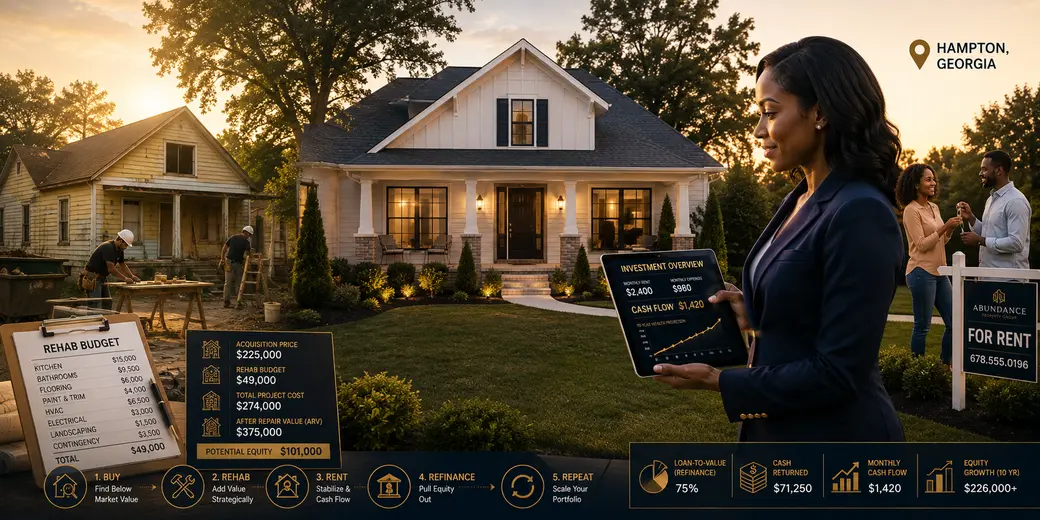
Executing the BRRRR Method in Hampton: Buy, Rehab, Rent, Refinance, Repeat
The BRRRR strategy sounds simple on paper: Buy, Rehab, Rent, Refinance, Repeat.
But the difference between a successful BRRRR and a property that traps your capital usually comes down to the numbers before you buy.
For investors looking at Hampton and the South Metro Atlanta market, the goal isn't simply finding a fixer-upper. You're looking for a property where the acquisition price, renovation budget, after-repair value (ARV), achievable rent, and eventual refinance all work together.
That means working backward from the exit before writing the offer.
What Is the BRRRR Method?
BRRRR stands for:
Buy – Acquire a property below its stabilized market value.
Rehab – Make strategic improvements that increase both marketability and value.
Rent – Place a qualified tenant and stabilize the property.
Refinance – Pursue longer-term financing based on the property's improved condition and value.
Repeat – If sufficient capital is recovered, redeploy it into another investment.
The objective isn't necessarily to get every dollar back.
A strong BRRRR deal should leave you with an income-producing asset while recovering enough capital to make your next acquisition possible.
The Hampton BRRRR Equation Starts With ARV
Before determining what you can pay for a property, estimate its after-repair value.
ARV should be supported by relevant comparable sales—not by the highest-priced renovated home you can find online.
Look closely at comparable properties with similar:
- Square footage
- Bedroom and bathroom count
- Lot size
- Age
- Construction style
- Garage configuration
- Renovation quality
- Neighborhood or subdivision
In Hampton, location matters significantly. Don't assume two properties with a Hampton mailing address will perform identically.
Local comparable sales should be verified before relying on any ARV.
A Sample BRRRR Deal in Hampton
Here's a hypothetical example to demonstrate how an investor might analyze a deal.
Assume you identify a property with:
| Investment Metric | Example |
|---|---|
| Purchase Price | $225,000 |
| Rehab Budget | $45,000 |
| Closing/Holding Costs | $15,000 |
| Total Project Cost | $285,000 |
| Target ARV | $375,000 |
That creates approximately $90,000 between total project cost and projected ARV before refinancing expenses, taxes, selling costs, or other obligations.
But that does not mean the investor automatically receives $90,000.
The refinance determines how much capital can actually be recovered.
Work Backward From the Refinance
Suppose, strictly for illustration, a lender ultimately allowed a refinance at 75% of the property's appraised value.
With a $375,000 appraisal:
$375,000 × 75% = $281,250
If your total project cost was $285,000, a $281,250 refinance would not return every dollar invested—and refinance closing costs could increase the amount of capital remaining in the property.
That's why experienced investors don't stop at:
"I'm buying it for $225,000 and it'll be worth $375,000."
They ask:
"After rehab, seasoning requirements, appraisal, lender limits, and refinance costs, how much of my original capital can I realistically recover?"
That is the BRRRR question that matters.
Your Purchase Price Creates the Margin
Let's change one number.
Imagine negotiating the same hypothetical property to $205,000 instead of $225,000.
If rehab and other project costs remained unchanged:
| Scenario | $225K Purchase | $205K Purchase |
|---|---|---|
| Acquisition | $225,000 | $205,000 |
| Rehab | $45,000 | $45,000 |
| Closing/Holding | $15,000 | $15,000 |
| Total Cost | $285,000 | $265,000 |
| Hypothetical ARV | $375,000 | $375,000 |
That $20,000 acquisition difference dramatically changes the refinance equation.
You make your money when you buy—and protect it during the renovation.
Rehab for Value, Not Emotion
A BRRRR renovation isn't the same as remodeling your personal residence.
Every upgrade should answer one of two questions:
Will this increase the property's supported value?
or
Will this improve its ability to attract and retain qualified tenants?
High-priority improvements often include:
- Roof and major systems when needed
- HVAC
- Electrical and plumbing issues
- Durable flooring
- Interior and exterior paint
- Functional kitchens
- Updated bathrooms
- Lighting
- Safety items
- Exterior maintenance
- Curb appeal
Be cautious about over-improving a rental beyond what comparable properties support.
Build a Rehab Contingency Into the Deal
The $40,000 renovation that becomes $58,000 can destroy a BRRRR strategy.
Older properties may reveal problems after closing that weren't obvious during the initial walkthrough.
Investors should consider contingency reserves for unexpected expenses.
The appropriate amount depends on the property's condition and scope of work, but your underwriting should account for the possibility that the renovation will not go exactly according to plan.
Rent Must Work After Refinancing
This is where BRRRR investors sometimes get distracted by equity.
A property can have significant equity and still be a weak rental.
After refinancing, calculate projected income against:
- Principal and interest
- Property taxes
- Insurance
- Property management
- Vacancy
- Repairs
- Capital expenditures
- HOA expenses, when applicable
- Utilities paid by the owner
Don't analyze cash flow using rent minus mortgage alone.
The property needs to survive real-world ownership.
Stress-Test the Hampton Rental
Instead of asking:
"What is the highest rent I could possibly get?"
Ask:
"Does this investment still work if rent comes in slightly lower than expected?"
Run multiple scenarios.
For example:
Optimistic: $2,600/month
Target: $2,450/month
Conservative: $2,300/month
Those figures are examples only—not current Hampton rental estimates.
Before purchasing, verify achievable rent using current rental comparables for the property's specific location, size, condition, and amenities.
If the deal only works at the most optimistic rent, your margin may be too thin.
Don't Forget the Refinance Rules
A BRRRR strategy depends heavily on the second "R."
Before buying, speak with lenders about:
- Loan-to-value limits
- Loan-to-cost restrictions
- Appraisal requirements
- Minimum credit requirements
- Debt-service requirements
- Seasoning periods
- Documentation of renovation costs
- Required property condition
- Reserve requirements
- Closing costs
Never build an investment strategy around the assumption that a lender will refinance the property exactly as projected.
Loan programs and underwriting standards vary.
The Appraisal Can Make or Break the Strategy
You might believe your renovated property is worth $400,000.
Your contractor might agree.
Your spreadsheet might agree.
The lender doesn't refinance based on your spreadsheet.
The appraisal must support the value.
That's why investors need to understand comparable sales before deciding how much to spend on acquisition and renovation.
If your projected ARV is aggressive, your entire capital-recovery strategy becomes vulnerable.
Think in Terms of Capital Left in the Deal
One of my favorite ways to evaluate a BRRRR opportunity is simple:
How much money will I still have trapped in the property after refinancing?
If you invest $100,000 of cash and recover $85,000, you've left $15,000 invested.
That isn't automatically bad.
If the resulting property has strong equity, sustainable cash flow, and fits your portfolio goals, leaving capital in the deal may be perfectly acceptable.
The mistake is expecting a full capital recovery and discovering after renovation that $40,000 or $50,000 must remain in the property.
Know your acceptable number before closing.
Why Hampton Can Be Worth Studying
For South Metro Atlanta investors, Hampton deserves consideration because it sits within a broader region experiencing residential, commercial, transportation, and employment growth.
But "Hampton" alone isn't an investment thesis.
Individual neighborhoods, subdivisions, school zones, property conditions, rental restrictions, and proximity to employment or transportation can produce very different outcomes.
The opportunity needs to work at the property level, not simply the ZIP-code level.
Your BRRRR Buy Box
Before searching for properties, create a written investment buy box.
For example:
Property: Single-family detached
Target: Value-add opportunity
Condition: Cosmetic-to-moderate rehab
ARV: Supported by renovated comparable sales
Rehab: Defined scope + contingency
Rent: Supported by current rental comps
Refinance: Pre-discussed with lender
Exit: Hold, refinance, or alternative disposition
Then establish your maximum acquisition price based on those numbers.
That keeps emotion out of the offer.
Final Thoughts
The BRRRR method isn't about finding the cheapest house in Hampton.
It's about finding the right spread between acquisition cost, renovation expense, stabilized value, rental performance, and refinance potential.
A successful investor understands all five stages before completing stage one.
Buy with margin.
Rehab with discipline.
Rent based on real comparables.
Refinance conservatively.
Repeat only when the numbers support it.
That's how BRRRR becomes an investment strategy instead of an expensive renovation project.
Thinking about executing a BRRRR strategy in Hampton or elsewhere in South Metro Atlanta?
Let's build your investment buy box first. I can help you evaluate potential acquisitions, analyze comparable sales, estimate realistic ARV ranges, identify rental comparables, and determine which properties deserve a deeper financial analysis before you write the offer.
Investment, lending, and tax decisions should be reviewed with the appropriate licensed financial, lending, legal, and tax professionals.
Frequently Asked Questions
What does BRRRR stand for?
BRRRR means Buy, Rehab, Rent, Refinance, Repeat. Investors acquire value-add properties, renovate them, stabilize them with rental income, refinance when appropriate, and potentially redeploy recovered capital.
How much should I pay for a BRRRR property in Hampton?
There is no universal purchase-price target. Your maximum offer should be calculated from the property's supported ARV, renovation costs, carrying costs, expected rent, financing terms, and required investment return.
How much rehab is too much?
It depends on the ARV and rental market. If additional improvements don't produce sufficient value or rental benefits, they may reduce your return rather than improve it.
Can I refinance immediately after renovating?
Not necessarily. Lenders have different seasoning, appraisal, documentation, equity, and underwriting requirements. Confirm the refinance strategy with prospective lenders before acquiring the property.
What happens if the property doesn't appraise at my projected ARV?
A lower appraisal can reduce the amount available through refinancing, leaving more investor capital in the property. That's why conservative ARV analysis is critical.
Does every BRRRR property need to return 100% of my original cash?
No. Some investors intentionally leave capital invested if the property delivers sufficient equity, cash flow, and long-term return. The appropriate target depends on your investment strategy.
Categories
Recent Posts