
The Red Zone: How to Navigate June's Shifting Absorption Rates (Without Losing Your Mind)
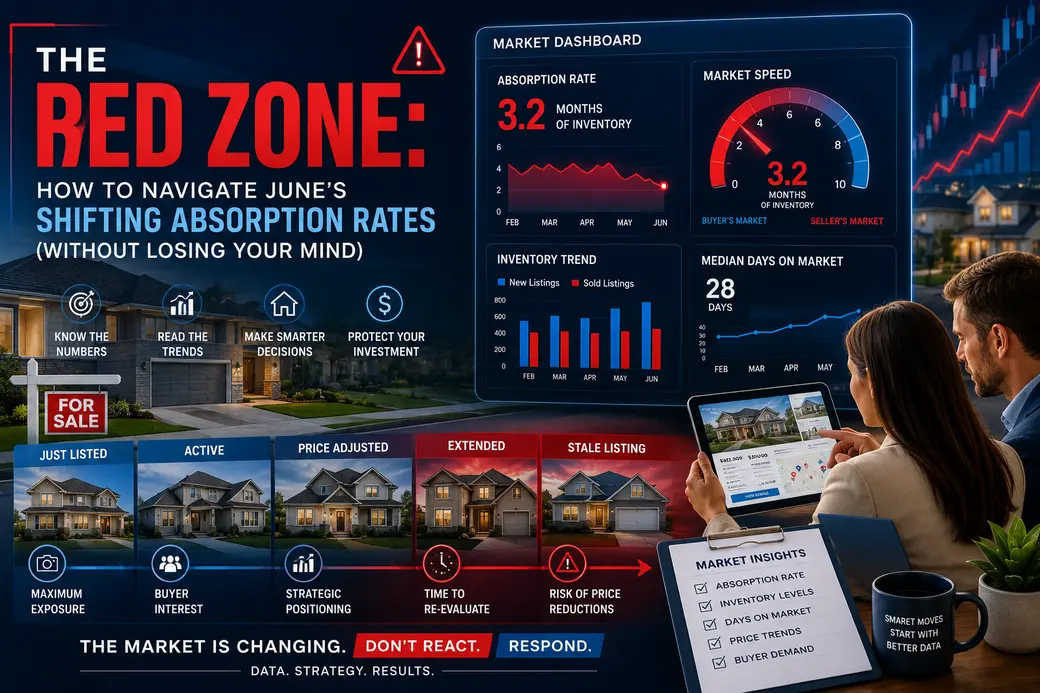
The Red Zone: How to Navigate June's Shifting Absorption Rates (Without Losing Your Mind)
One of the most misleading statistics in real estate is "Days on Market."
Buyers see a property sitting for 30, 45, or even 60 days and immediately assume something is wrong.
Sellers see homes taking longer to sell and panic that the market is crashing.
Neither conclusion is necessarily true.
As we move deeper into the summer market, understanding what is really happening behind the numbers has become more important than ever. The market isn't broken. It's shifting.
And one of the most important metrics to watch isn't Days on Market at all—it's absorption rate.
Understanding the difference can help buyers make smarter decisions and help sellers avoid costly mistakes.
What Is an Absorption Rate?
Absorption rate measures how quickly available homes are being purchased in a specific market.
In simple terms, it answers one question:
If no new homes came on the market, how long would it take to sell all existing inventory?
The absorption rate provides a much clearer picture of market balance than a single home's Days on Market figure.
It helps determine whether:
- Buyers have leverage
- Sellers have leverage
- Inventory is increasing
- Inventory is shrinking
- Competition is accelerating or slowing
This is why many professional investors and market analysts pay close attention to absorption rates when evaluating opportunities.
The Days on Market Trap
Days on Market can be useful—but only when viewed in context.
Many buyers assume:
More Days on Market = Bad House
That's often incorrect.
A home may have accumulated days because:
- It was initially overpriced
- Marketing was weak
- The property was listed during a slow period
- Buyers overlooked it during peak competition
- The seller recently improved pricing
Meanwhile, another home may sell quickly simply because it was aggressively underpriced.
Days on Market alone rarely tells the whole story.
Why June Feels Different
June often creates what many agents call the "red zone" of the summer market.
More homes are being listed.
More buyers are actively searching.
Families are trying to move before school starts.
Investors are evaluating opportunities before the second half of the year.
As inventory increases, buyers gain more choices and sellers face more competition.
The result?
Homes may spend slightly longer on the market—even when demand remains healthy.
That's why looking only at Days on Market can create a distorted view of what's actually happening.
The Market Is Normalizing, Not Crashing
Many homeowners became accustomed to the extreme seller's market conditions of recent years.
Listings received multiple offers within days.
Buyers waived contingencies.
Homes sold almost immediately.
That environment was unusual.
Today's market is moving toward something much healthier: balance.
Balanced markets typically provide:
- More inventory
- Better buyer decision-making
- More realistic pricing
- Healthier negotiations
- Greater transaction stability
Longer marketing times don't necessarily indicate weakness.
In many cases, they indicate normalization.
How Buyers Should Interpret Longer Market Times
For buyers, increasing inventory can create opportunities.
Rather than assuming a home is undesirable because it has been listed for several weeks, ask:
Has the Price Changed?
Recent price adjustments may create value opportunities.
How Does It Compare to Similar Homes?
Comparable sales often provide more insight than market time alone.
Is There a Structural Advantage?
Look for features that create long-term value:
- Better location
- Larger lot
- Flexible floor plan
- Income-producing potential
- Multigenerational living options
These factors often matter more than how long a property has been listed.
How Sellers Should Respond
One of the biggest mistakes sellers make is comparing today's market to conditions from two years ago.
Instead, focus on:
Accurate Pricing
The market rewards realistic pricing strategies.
Strong Presentation
Professional photography, staging, and marketing remain critical.
Market Awareness
Understanding local inventory trends helps set realistic expectations.
Strategic Positioning
Highlight functional advantages and buyer benefits rather than simply listing features.
The goal is not to chase yesterday's market.
The goal is to win in today's market.
Why Absorption Rate Matters More Than Ever
Absorption rates provide context.
A home sitting for 40 days may seem concerning until you discover inventory has doubled across the area.
Likewise, a home selling in five days may seem impressive until you realize it was significantly underpriced.
Absorption rate helps connect the dots.
It measures market velocity rather than focusing on a single property.
For serious buyers, sellers, and investors, understanding market velocity often leads to better decisions than relying on headline statistics.
The Smartest Players Watch Trends, Not Headlines
The most successful real estate decisions are rarely made based on a single metric.
They are made by understanding:
- Inventory levels
- Absorption rates
- Pricing trends
- Buyer demand
- Local market conditions
When viewed together, these indicators tell a much more accurate story.
And right now, that story is one of a market finding balance—not one falling apart.
Final Thoughts
The next time you see a property with a higher Days on Market count, resist the urge to jump to conclusions.
Real estate markets are complex, and individual statistics rarely tell the full story.
As inventory grows and absorption rates shift this summer, buyers and sellers who understand the broader picture will be better positioned to identify opportunities, avoid costly assumptions, and make smarter decisions.
The key isn't watching one number.
It's understanding the story behind it.
Want to know what the numbers are really saying in your local market?
Let's break down current inventory levels, absorption rates, pricing trends, and buyer demand so you can make informed decisions whether you're buying, selling, or investing.
FAQs
What is an absorption rate in real estate?
Absorption rate measures how quickly available inventory is being sold within a specific market.
Is a high Days on Market count always bad?
No. Market time should be evaluated alongside pricing, inventory levels, and overall market conditions.
What is considered a balanced market?
A balanced market generally occurs when neither buyers nor sellers have a significant advantage.
Why are homes taking longer to sell this year?
Increasing inventory and more buyer choices can naturally extend marketing times without indicating market weakness.
Which metric is more important: Days on Market or Absorption Rate?
Both are useful, but absorption rates often provide better context for understanding overall market conditions.
Categories
Recent Posts